
Verdict
MiPhi Storm 1100X delivers dependable 10Gbps-class performance in a solid, well-built chassis with broad compatibility and a generous 5-year warranty. While its use of a USB 3.2 Gen 2×2 (20Gbps) interface initially suggests higher performance, the drive is firmly positioned alongside other 10Gbps portable SSDs in real-world throughput. Its value will be defined by its pricing, not its raw specs.
What’s iLL
- Durable, professional-grade metal enclosure with drop resistance
- Includes both USB Type-C and Type-A cables for wide device compatibility without compromising performance
- Phison PS2251-17 controller delivers consistent 10Gbps-class performance
- Competitive 5-year warranty backing the drive
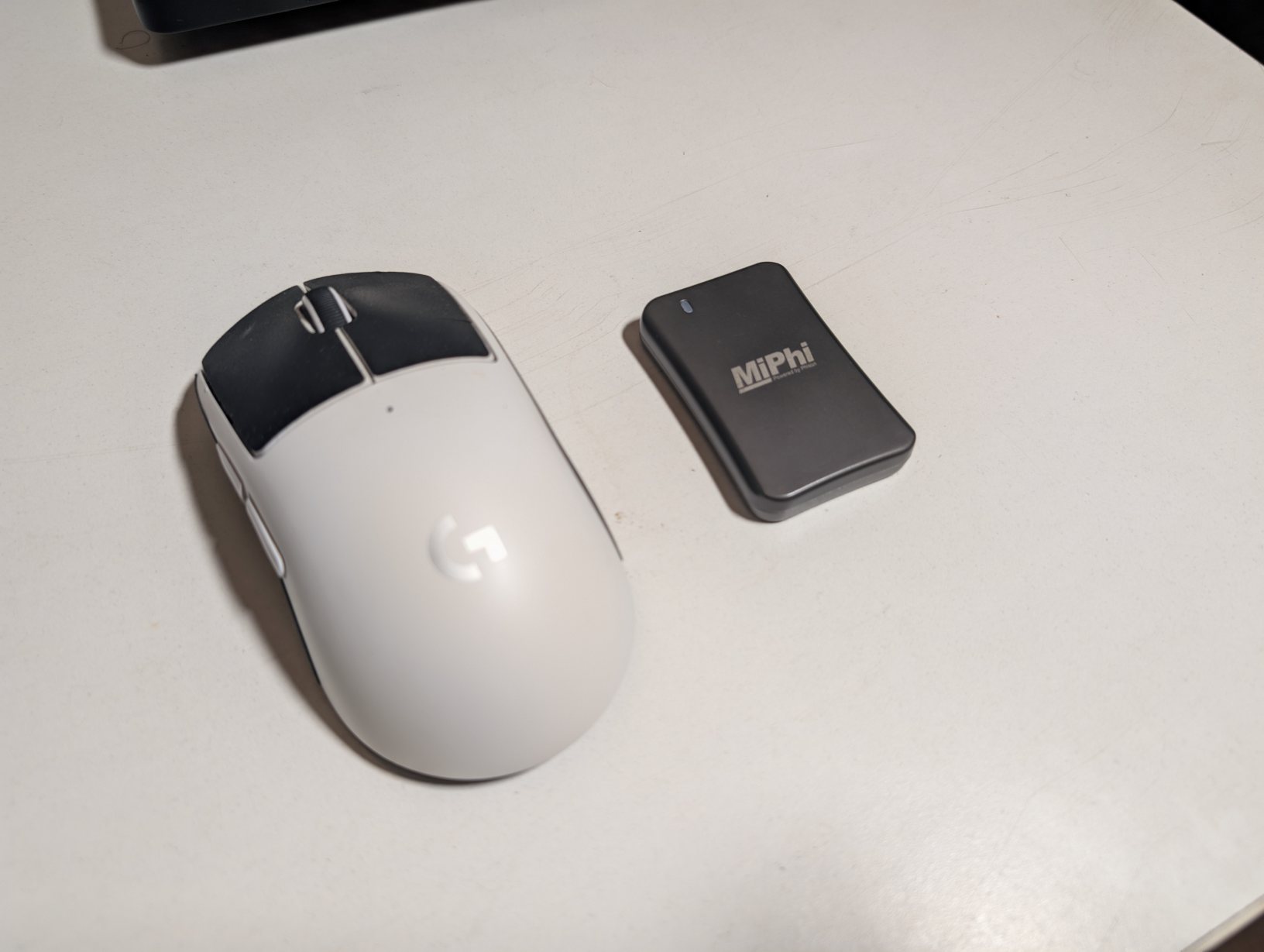
- Compact size with no encumbrance whatsoever
What’s Not
- Performance matches USB 3.2 Gen 2 (10Gbps) drives, not 20Gbps-capable ones
- Competition offers drives with similar performance at a lower price point
Introduction
MiPhi Semiconductors Private Limited, a joint venture established between Micromax Informatics (India) and Phison Electronics Corporation (Taiwan), has introduced the Storm 1100X external Solid State Drive (SSD). This product represents the venture’s entry into the consumer portable storage market. The partnership strategically combines Micromax’s extensive regional market access, manufacturing capabilities aligned with the “Make in India” initiative, and established customer relationships within India, with Phison’s globally recognized leadership in NAND flash controller technology and storage solutions.
Phison’s technical credentials include a portfolio of over 2,000 patents and significant R&D investment; notably, approximately one in five SSDs shipped worldwide utilizes Phison controller solutions.
This review evaluates the technical specifications, physical characteristics, and performance metrics of the MiPhi Storm 1100X, specifically noting its use of the USB 3.2 Gen 2×2 interface paired with specified speeds typical of the lower Gen 2 standard, reflecting a product with significant technical pedigree.
The partnership strategically combines Micromax’s extensive regional market access, manufacturing capabilities aligned with the “Make in India” initiative, and established customer relationships within India, with Phison’s globally recognized leadership in NAND flash controller technology and storage solutions.
Product Specifications
The technical specifications for the MiPhi Storm 1100X, reflecting the information provided on the product packaging, are detailed in Table 1.
Table 1: MiPhi Storm 1100X Specifications
| Feature | Specification |
| Model | MiPhi Storm 1100X |
| Form Factor | External SSD |
| Available Capacities | 1TB, 2TB |
| Host Interface | USB 3.2 Gen 2×2 Type-C |
| Interface Speed | Up to 20Gbps |
| Backward Compatibility | USB 3.2 Gen 2, Gen 1, USB 2.0, USB 1.1 |
| Sequential Read | Up to 1100 MB/s |
| Sequential Write | Up to 1000 MB/s |
| Controller | Phison PS2251-17 (U17) |
| NAND Flash Memory | TLC / QLC |
| Enclosure Material | Metal |
| Drop Resistance | Specified up to 2 meters |
| Error Correction | LDPC ECC (4th Generation) |
| Thermal Control | Integrated Thermal Sensor |
| OS Support | Windows XP+, macOS 10.8+, Linux kernel 2.4.10+ |
| Dimensions (L×W×H) | 65 mm × 42.7 mm × 11 mm |
| Weight | Approx. 97.1 g |
| Warranty | 5 Years |
| India Launch Price (1TB) | ₹12,999 (Check current market price) |
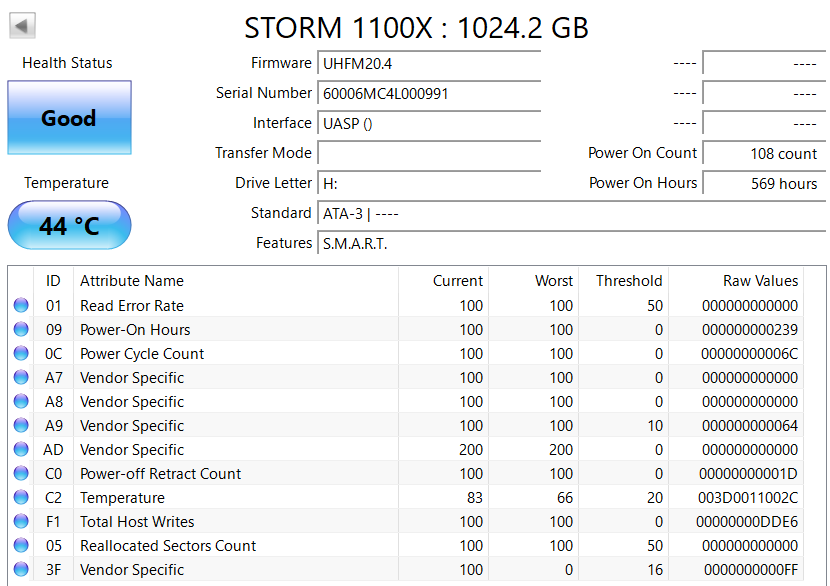
Here are specifications as per HWiNFO 64 and CrystalDiskInfo, which verify to the declared specifications by MiPhi.
CrystalDiskInfo
Physical Characteristics and Build Quality
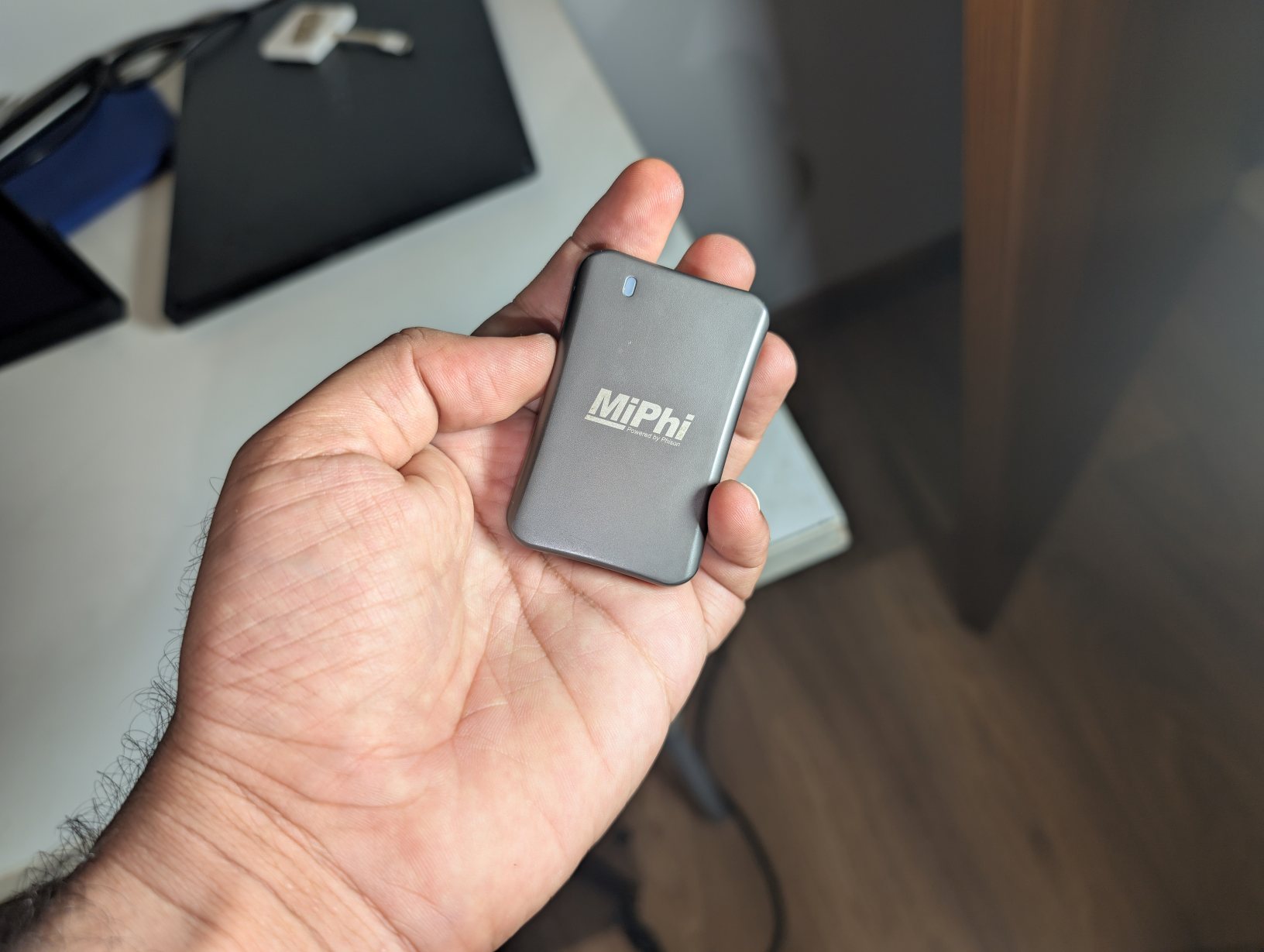
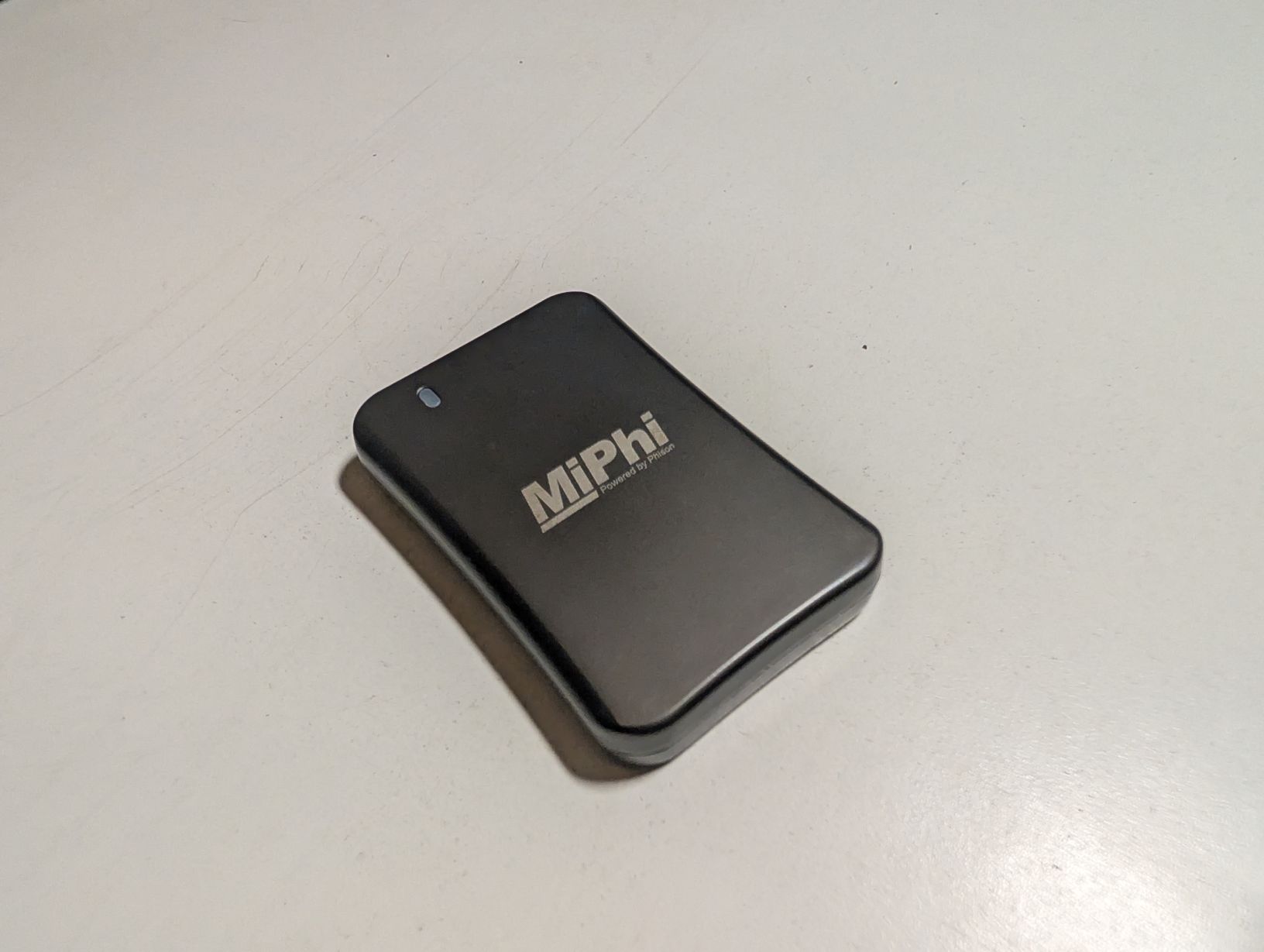
The Storm 1100X employs a metal enclosure, finished in a dark grey color that presents a professional aesthetic. This construction contributes to its structural rigidity, offers a premium tactile experience, and likely aids thermal dissipation. The unit’s dimensions (65 x 42.7 x 11 mm) ensure a compact physical footprint, making it highly portable despite its relatively substantial weight of approximately 97.1 grams.
The Storm 1100X employs a metal enclosure, finished in a dark grey color that presents a professional aesthetic. This construction contributes to its structural rigidity, offers a premium tactile experience, and likely aids thermal dissipation.
MiPhi specifies drop resistance for the device from heights up to 2 meters. However, the product lacks an official Ingress Protection (IP) rating, indicating no certified resistance against particulate matter or liquid ingress, which is a factor for users requiring operation in more demanding environments. However, for regular use by regular people, the MiPhi Strom 1100X’s body is still very much on the resilient side.
We performed four rounds of drop tests from varying heights starting at 300 cm all the way up to 1000 cm (1 meter). The Storm 1100X withstood the impact without any dent whatsoever, coming out with only minor sustained scratches visible to the squinting eye. This level of protection in a 1TB (our test drive) and the 2TB variant brings in legit practicality, versatility and durability for an external drive meant to have a cocktail of use cases.
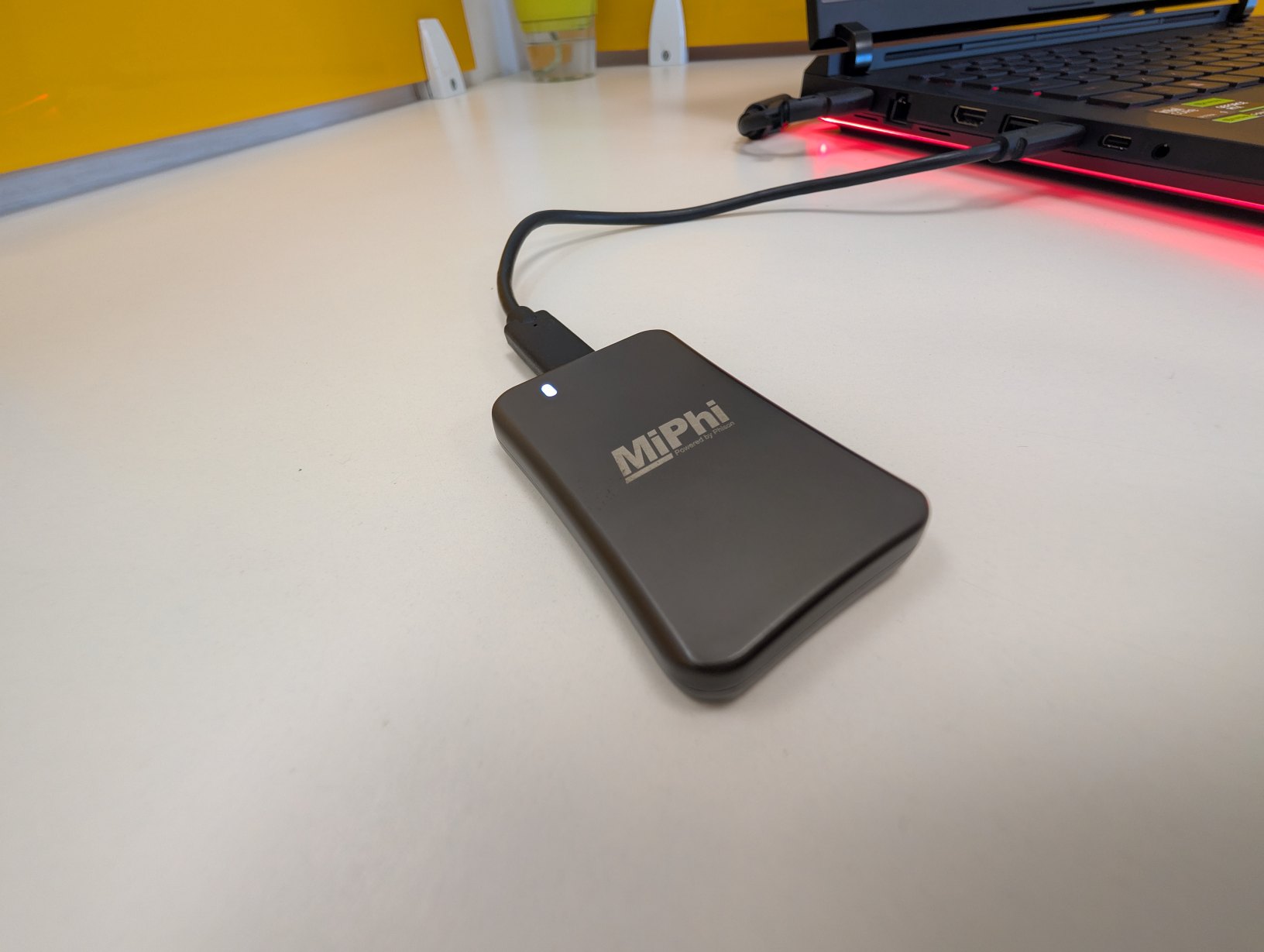
A significant practical advantage, and a well thought out move by MiPhi is the inclusion of both a USB Type-C to Type-C cable and a USB Type-C to Type-A cable in the retail package. Both cables support the USB 3.2 Gen 2 interface, and rightly so, are well endowed with proper jacketing and thickness. This thoughtful provision directly addresses compatibility challenges across diverse host systems, ensuring users can connect the drive to both modern Type-C ports (required for potential Gen 2×2 speeds) and legacy Type-A ports without needing to source additional adapters.
A significant practical advantage, and a well thought out move by MiPhi is the inclusion of both a USB Type-C to Type-C cable and a USB Type-C to Type-A cable in the retail package. Both cables support the USB 3.2 Gen 2 interface, and rightly so, are well endowed with proper jacketing and thickness.
Internal Architecture and Technology
This drive utilizes the USB 3.2 Gen 2×2 interface standard via a Type-C connector, enabling a maximum theoretical data transfer rate of 20Gbps. Internal storage is provided by Triple-Level Cell (TLC) or Quad-Level Cell (QLC) NAND flash memory components.
HWiNFO 64
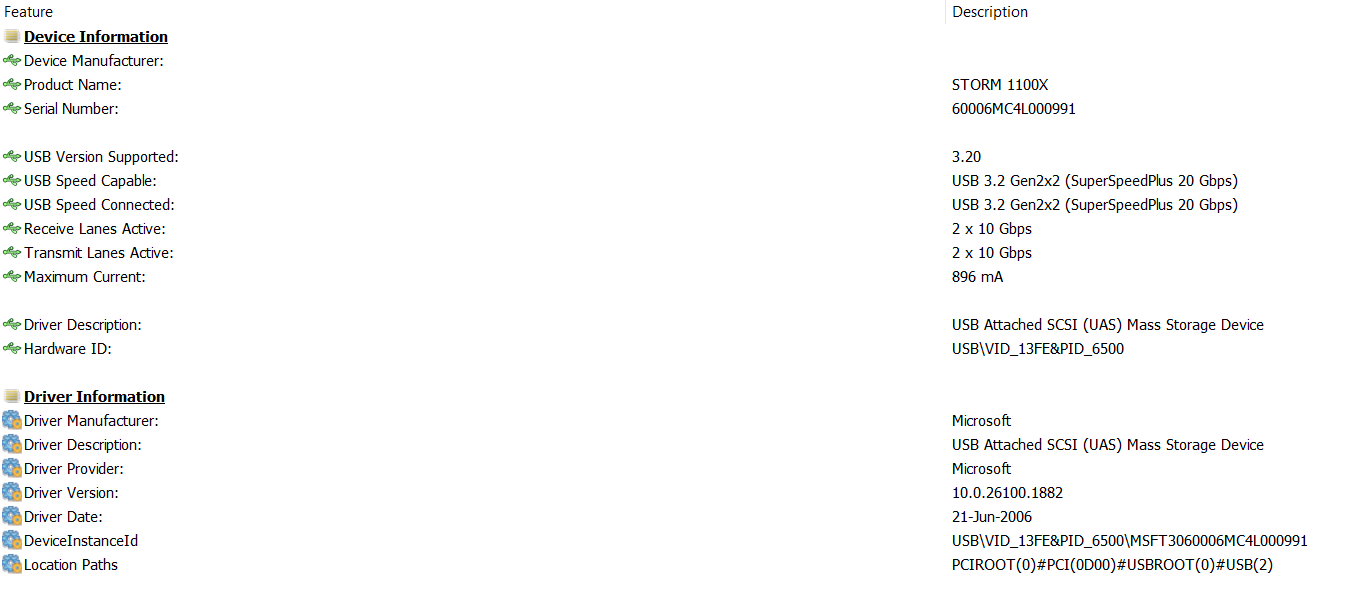
Data management and host communication are handled by the Phison PS2251-17 (U17) controller. This specific controller model is engineered by Phison to support the USB 3.2 Gen 2×2 (20Gbps) standard, placing capable hardware at the core of the device. It integrates Phison’s 4th generation Low-Density Parity-Check (LDPC) error correction algorithms, designed to enhance data integrity and extend the endurance of the NAND flash memory.
Performance
Despite utilizing the high-bandwidth USB 3.2 Gen 2×2 (20Gbps) interface and the compatible PS2251-17 controller, the MiPhi Storm 1100X is rated for maximum sequential read speeds of 1100 MB/s and write speeds of 1000 MB/s. These performance levels are characteristic of drives operating over the slower USB 3.2 Gen 2 (10Gbps) interface. Therefore, while connected to a Gen 2×2 port, the drive’s performance is expected to be limited to these specified speeds, likely due to the performance characteristics of the employed NAND flash or other internal design choices.
Here are the CrystalDiskMark performance numbers, across data sizes starting from 16MB all the way up to 64GB. Each test went through five runs.
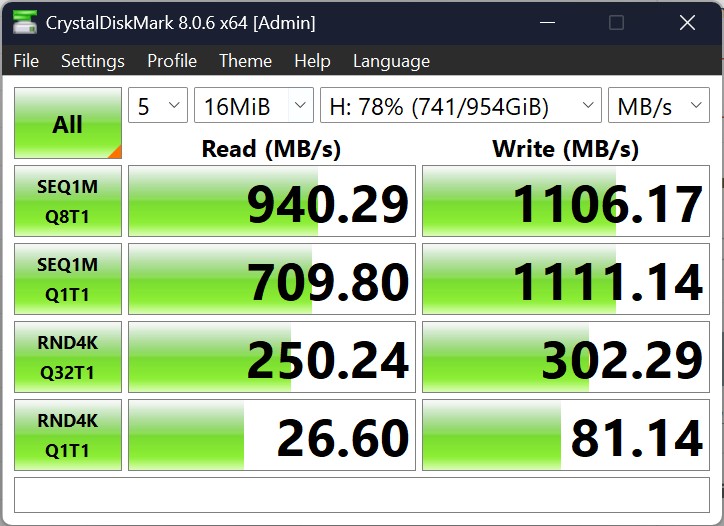
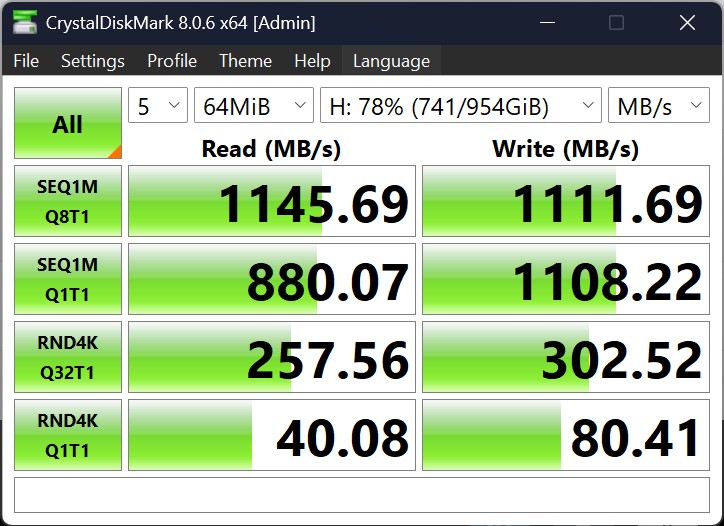
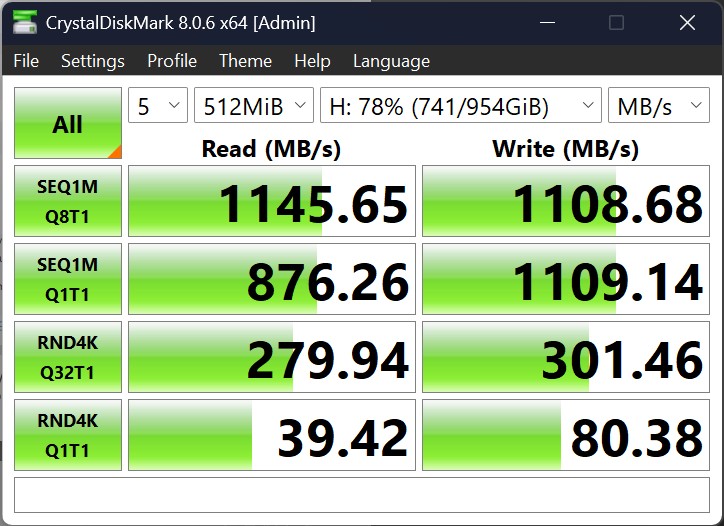
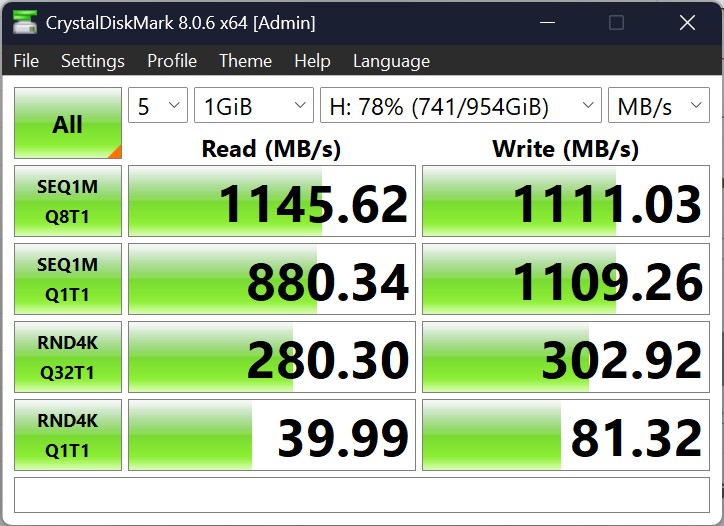
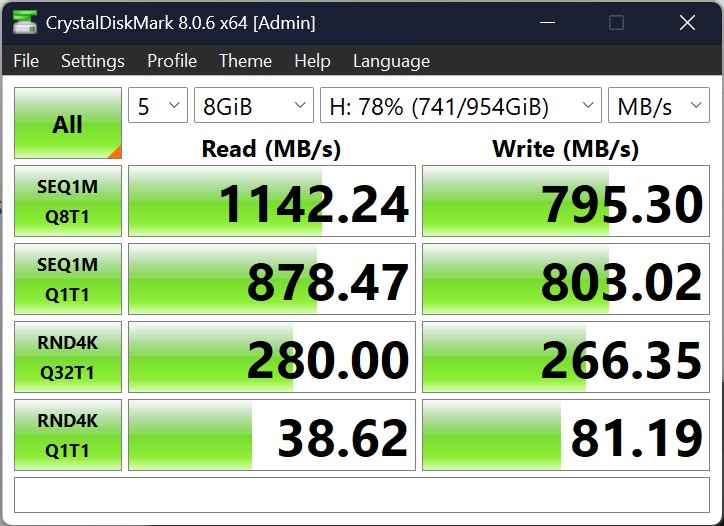
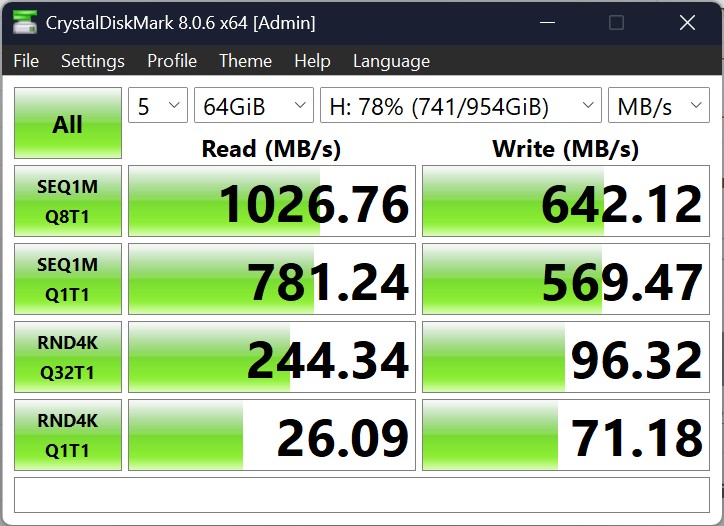
Performance benchmarks utilizing large sequential file transfers yield results approaching the 1100/1000 MB/s ratings. Real-world transfer rates remain contingent upon factors including workload characteristics (large sequential files vs. small random files), host system capabilities, OS overhead, and drive condition.
Compared to other external SSDs:
- Its specified performance aligns it directly with drives utilizing the USB 3.2 Gen 2 (10Gbps) interface, such as the SanDisk Extreme Portable SSD V2, WD My Passport SSD (current revisions), Kingston XS1000, and Crucial X9.
- It does not offer the ~2000 MB/s transfer speeds found in other drives that fully leverage the USB 3.2 Gen 2×2 interface potential, like the SanDisk Extreme Pro Portable SSD V2 or Crucial X10 Pro, despite sharing the same interface standard and controller capability.
The primary benefit of the Gen 2×2 interface and controller on this specific model appears limited in terms of realized speed, as performance aligns with the preceding 10Gbps standard.
Thermal Management
The device incorporates an internal thermal sensor. This component monitors the operating temperature of the drive. The system is expected to modulate performance (via thermal throttling) if necessary, during sustained operations to maintain temperatures within the specified operating range (0°C to 70°C) and ensure stability. During our test runs which incorporated data sizes as high as 64GB over five runs, we experienced no thermal throttling as such, suggesting good thermal management.
Conclusion
The MiPhi Storm 1100X presents an unusual configuration, pairing a high-bandwidth USB 3.2 Gen 2×2 interface and the capable Phison PS2251-17 controller with sequential read/write speeds of 1100/1000 MB/s, typical of the slower USB 3.2 Gen 2 (10Gbps) standard. Its construction utilizes a durable metal enclosure with a professional aesthetic and specified drop resistance. The inclusion of both USB Type-C and Type-A cables is a distinct practical advantage for compatibility. The 5-year warranty is competitive.
Given its specified performance level, the drive competes directly with mainstream 10Gbps portable SSDs. The inclusion of the Gen 2×2 interface hardware does not translate into higher advertised speeds for this particular model. Therefore, its value proposition should be assessed based on its current market price compared to other external SSDs offering similar ~1100 MB/s performance, rather than against higher-performing 20Gbps drives.
While this specific model operates at 10Gbps-class speeds, the utilization of the Gen 2×2 interface hardware suggests the underlying platform could potentially support higher throughput. Achieving speeds closer to the 2000 MB/s potential of the interface would necessitate different internal component configurations, likely impacting production cost and retail price. It remains to be seen if MiPhi will introduce future models that fully leverage the capabilities of this higher-speed interface, building further on the pedigree established by its parent companies.