
NVIDIA’s Blackwell architecture was built around one central promise: that AI-powered rendering could fundamentally change what’s possible in real-time graphics. Resident Evil Requiem – Capcom’s most technically ambitious game to date, might just be the title that proves that promise isn’t marketing, contrary to many doubters (read: conspiracy theorists) still believe. Path Tracing, DLSS 4.5, Multi Frame Generation, Ray Reconstruction, and Reflex are all baked in RE Requiem from day one. We ran it on our RTX 5090 at 4K Ultra to see exactly how the RTX 5000 series’ AI feature stack performs under real gaming conditions, and what it means for the rest of the Blackwell lineup.
Let’s get into it.
Test Rig
CPU: Intel Core Ultra 9 285K
Motherboard: ASUS ROG MAXIMUS Z890 Extreme
RAM: Kingston Fury Renegade 48 GB (2× 24 GB) @ 7200 MT/s
GPU: AORUS RTX 5090 Master
Storage: Kingston G2 Gen 5 2TB NVMe
Monitor: MSI 321UP 4K (3840 × 2160)
Settings: Ultra / Path Tracing enabled across all tests
Driver: 591.86
Benchmarks were run with Path Tracing enabled, all sliders set to their maximus, all graphics features enabled: no compromises on the settings side. This is the most demanding configuration the game offers, which makes it the best possible stress test for what Blackwell’s AI rendering features are actually capable of. Capcom built a very scalable engine into RE Requiem.
The RTX 5000 Series & RE Requiem: Why This Matters
The RTX 5000 “Blackwell” lineup – 5090, 5080, 5070 Ti, 5070, 5060 Ti and down – is the first generation of consumer GPUs designed from the ground up around AI-assisted rendering as a first-class feature rather than a bonus. The 4th-gen RT Cores and 5th-gen Tensor Cores in every Blackwell card are what make DLSS 4.5, Multi Frame Generation, and Ray Reconstruction possible. RE Requiem is essentially a showcase for all three working in concert.
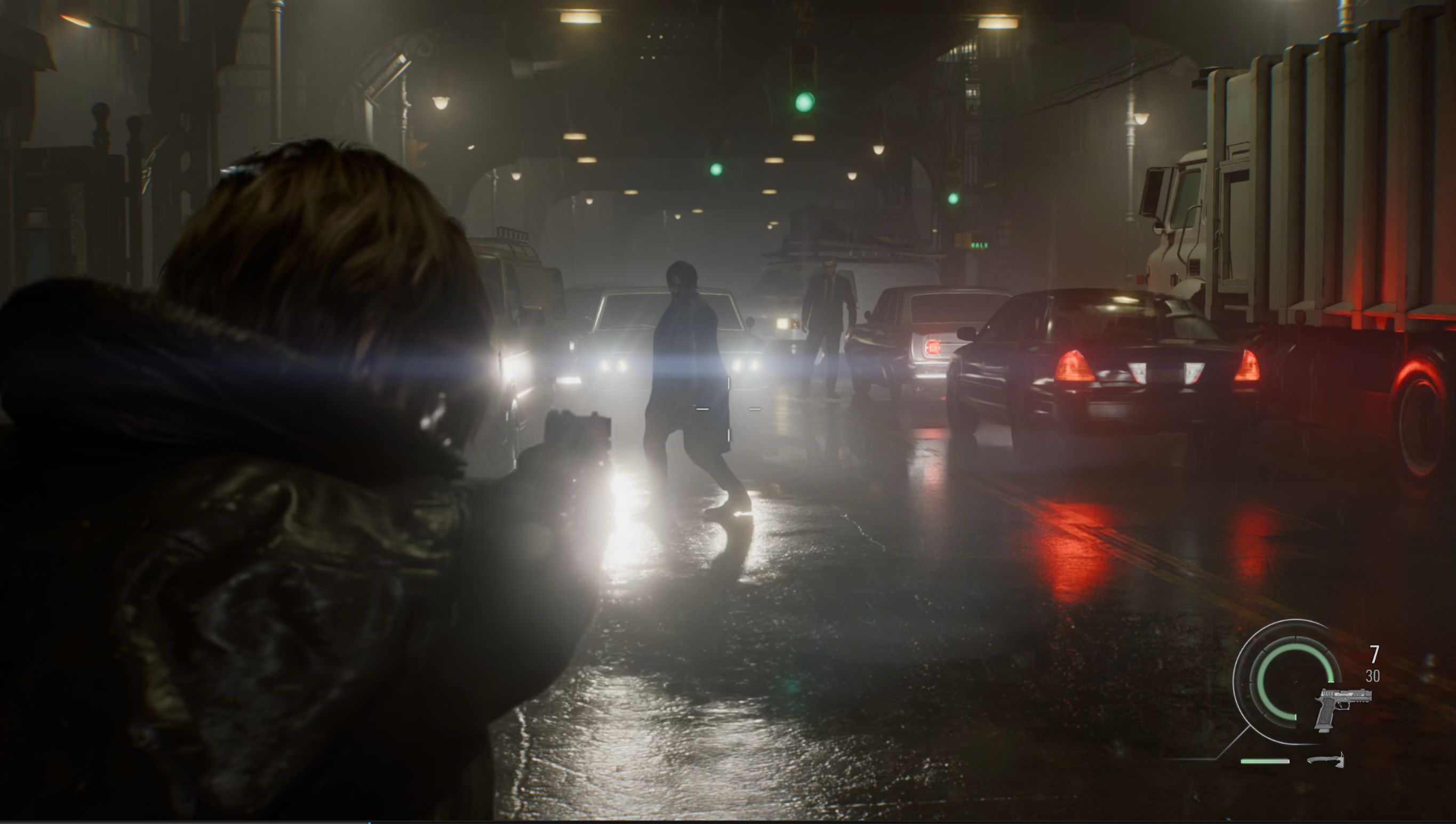
Our tested card is the flagship AORUS Master RTX 5090 with its 32 GB of GDDR7 and 92 billion transistors – but the DLSS and MFG technology stack is present across the entire RTX 5000 lineup. The key difference as you move down the stack is the base rendered frame rate you’re starting from, and by extension, how hard MFG has to work to get you to a playable experience. The 5090’s numbers here represent the ceiling of what Blackwell can do – and they show just how powerful these tools are even when you’re not starting from a strong base FPS.
The Full Benchmark Table
4K Ultra, Path Tracing On — RTX 5090
| DLSS Mode | MFG | Avg FPS | Notes |
|---|---|---|---|
| DLAA | Off | 37 | True GPU ceiling – no upscaling, no frame gen |
| DLAA | 2× | 77 | DLAA image quality with usable performance |
| DLAA | 3× | 111 | The sweet spot for high-refresh displays |
| DLAA | 4× | 137 | Best Image Quality in the game, near-144 FPS |
| Quality | Off | 76 | Strong no-MFG baseline |
| Quality | 2× | 144 | The headline number – 144 FPS, Path Tracing, 4K |
| Balanced | Off | 92 | Noticeable Image Quality degradation – skip it |
| Auto | Off | 118 | Highest single-GPU number; dynamic mode selection |
Breaking Down the Numbers
DLAA + MFG: The Blackwell Showcase
DLAA runs at native resolution – no upscaling, just AI anti-aliasing. At 37 FPS with MFG off, you’re looking at the raw 5090 render throughput: this is what the GPU physically draws at 4K Ultra Path Tracing, nothing added. It’s playable on its own, but it’s the essential baseline for understanding everything else.
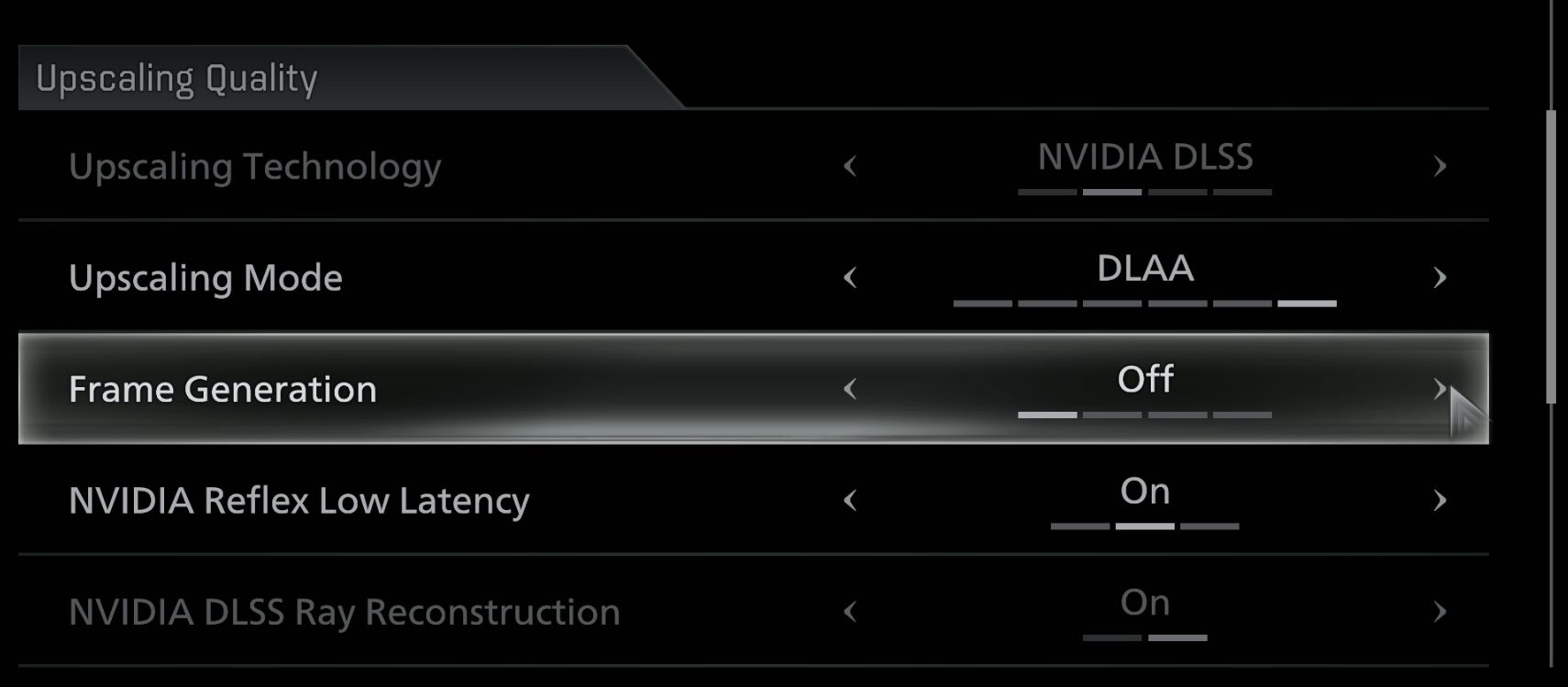
This is where Multi-frame Generation (MFG), a feature exclusive to the RTX 5000 Blackwell series, changes the equation entirely. MFG uses Tensor Cores to generate additional frames in between rendered frames – 2×, 3×, or 4× your base output. The results from DLAA are a clean illustration of this:
- DLAA + MFG 2× → 77 FPS (rendered frames × 2)
- DLAA + MFG 3× → 111 FPS (rendered frames × 3)
- DLAA + MFG 4× → 137 FPS (rendered frames × ~4)
The scaling is remarkably linear. And what makes this special is that you’re achieving 137 FPS while running DLAA – the highest image quality mode available in the game. In very rare cases, we did experience upscaling artifacts, mostly with indoor shadows. The occurrence is very sporadic though, most may not even notice it. NVIDIA Reflex keeps latency in check throughout, and in a survival horror game like RE Requiem where you’re not pulling off frame-perfect inputs, the slight MFG latency overhead is essentially imperceptible. Still, the latency at 4×MFG was noticeable, even with Reflex enabled, which is the reason why we haven’t recommended it.
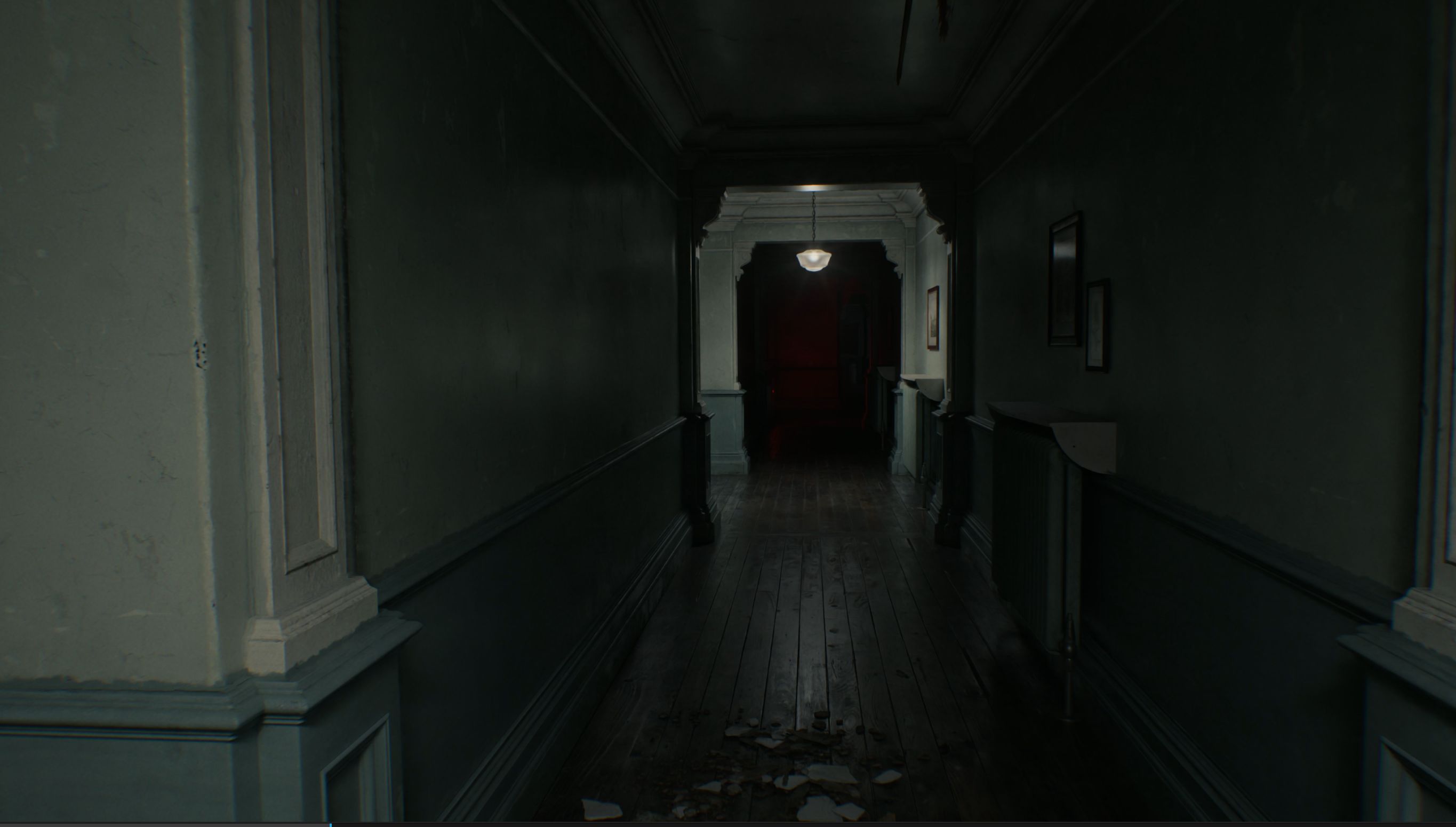
For the broader RTX 5000 lineup, this has big implications. A 5080 with a ~22 FPS DLAA base in Path Tracing could reasonably hit 66 FPS with MFG 3×. A 5070 Ti starting around 15 FPS native could push to 60+ FPS. Path Tracing takes the graphics of RE Requiem to another level, add to that the game’s strong atmosphere. The AI are making Path Tracing viable on hardware that would otherwise be completely excluded from the experience.
DLSS Quality: The 144 FPS Config
Quality mode renders at ~67% of native resolution before DLSS upscales to 4K. The image quality difference versus DLAA is real but subtle – you’d need a side-by-side to reliably spot it in most scenes. In return, the GPU gets meaningful breathing room.
76 FPS at Quality with no MFG is already a solid, playable experience. But stack MFG 2× on top and you land at 144 FPS – the single most important number in this entire test. Full Path Tracing. Ultra settings. 4K. 144 FPS. If you own a 144 Hz display and a 5090, this is your config.
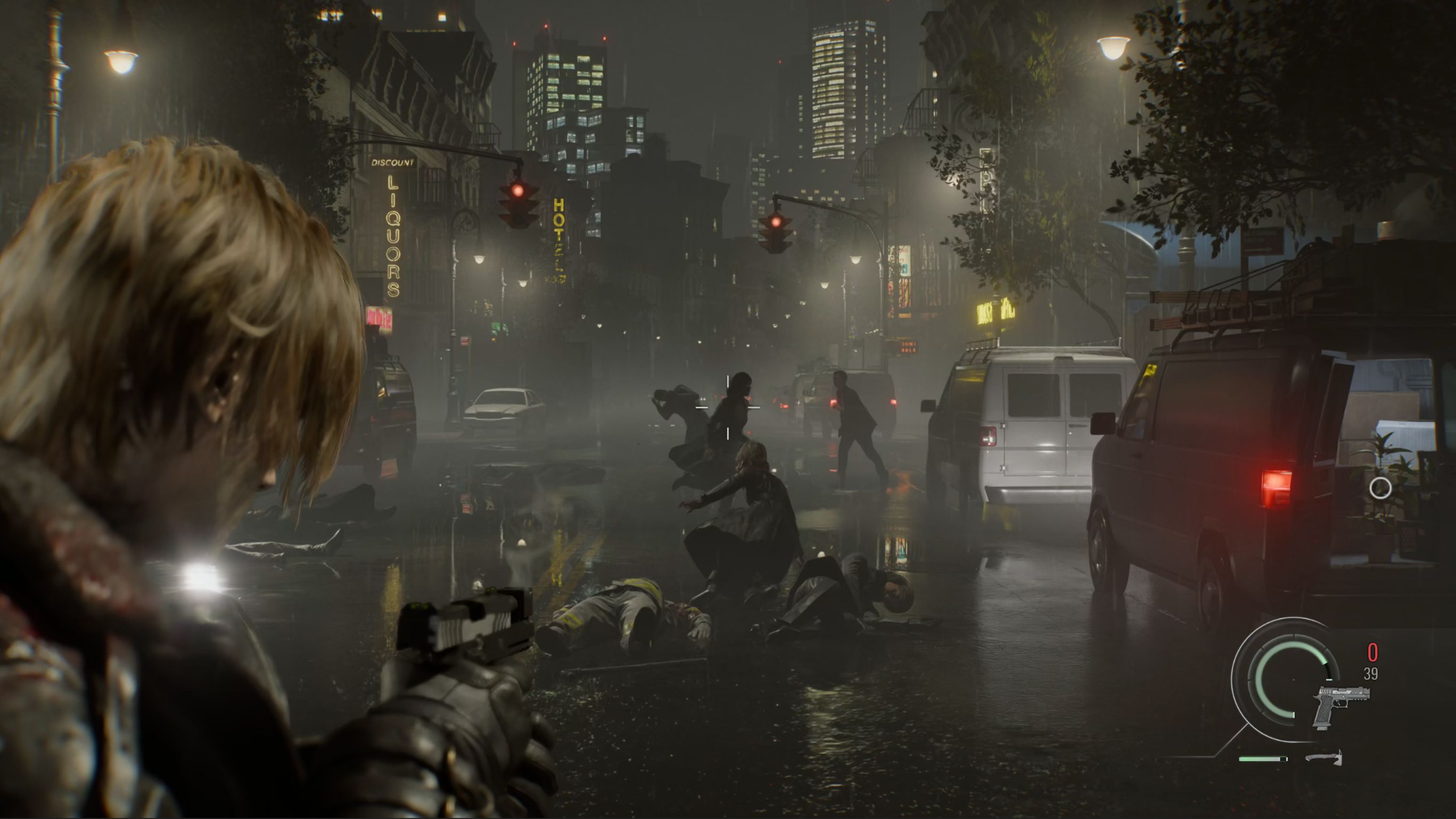
It also speaks to what DLSS 4.5 Quality mode has become. On previous generations, DLSS Quality at 4K still had visible reconstruction artifacts in demanding scenes. Blackwell’s transformer-based DLSS model is a generational leap in upscaling quality, Quality mode in RE Requiem looks exceptional, and the 144 FPS result it enables makes it the most practically useful config for most users.
DLSS Balanced: Pass
92 FPS with MFG disabled at Balanced sounds good until you see it in motion. RE Requiem’s detailed environmental geometry and particle-heavy lighting push Balanced mode’s reconstruction hard, and the degradation is visible – particularly in motion, where fine details blur and and general sharpness degrades. The gap between Quality (76 FPS) and Balanced (92 FPS) doesn’t justify the image quality loss, especially when MFG can close that gap for free. If you need more headroom than Quality gives you, reach for MFG before you drop DLSS modes.
DLSS Auto: The Sleeper Pick
Auto mode lets NVIDIA’s driver dynamically select the optimal DLSS preset on a scene-by-scene basis, and it posted 118 FPS – the best no-MFG result across all modes. Impressive, and worth noting as a strong option for players who want maximum FPS without managing their own settings. The caveat is visual consistency: some scenes will be sharper than others as the driver shifts modes. For a story-driven, atmospheric game like RE Requiem, this is largely a non-issue, but it’s worth knowing.
How Performance Scales Across the RTX 5000 Lineup
Our testing was done on the 5090, but these numbers have direct implications for the rest of the Blackwell stack. A few things to understand:
MFG multiplies rendered frames, not perceived reality. When MFG 4× takes 37 FPS to 137 FPS, those extra 100 frames are AI-generated between real rendered frames. The motion looks smooth, but your inputs are still being processed at the 37 FPS render rate. NVIDIA Reflex 2 helps minimize felt latency, and in a cinematic horror game this distinction barely matters – but it’s worth understanding before applying this logic to competitive shooters.
The lower your base FPS, the harder MFG works for you – but diminishing returns kick in. At the 5090’s 37 FPS DLAA base, MFG 4× produces an excellent result because each generated frame has a strong source to interpolate from. On a 5070 at perhaps 10–12 FPS native Path Tracing, MFG 4× would be doing significantly heavier lifting and image quality could suffer. Path Tracing at 4K Ultra is genuinely a 5090/5080 feature set right now.
At 1440p and 1080p, the 5000 series opens up Path Tracing much further down the stack. A 5070 Ti at 1440p with Path Tracing and DLSS Quality + MFG 2× should hit playable, potentially excellent framerates, and that’s the real story of Blackwell: democratizing Path Tracing across price points that would have made it unthinkable a generation ago.
The VRAM Story
Path Tracing at 4K Ultra consistently pulls around 17 GB of VRAM across all test configs. The 5090’s 32 GB GDDR7 has no trouble here whatsoever: clean experience throughout with zero stutter or texture streaming issues. The RTX 5080 at 16 GB would be cutting it fine in the most demanding scenes, and anyone running a 5070 or 5070 Ti (16 GB and 12 GB respectively) should expect to drop to 1440p or reduce some settings if they want a stable Path Tracing experience. RE Requiem is a genuinely next-gen title on the VRAM front.
A Note on DLSS Ray Reconstruction
RE Requiem forces Ray Reconstruction on whenever Path Tracing is enabled – there’s no way to turn it off. As of launch it defaults to Preset D, and there’s currently no in-game or NVIDIA App option to switch to the newer Preset M or L. In high-motion scenes, this introduces some ghosting that’s noticeable if you’re looking for it. It’s not game-breaking, RE Requiem isn’t exactly a fast-paced game, but it’s a rough edge on an otherwise exceptional launch. NVIDIA and Capcom need to push an update here. It’s the one asterisk on what is otherwise one of the best PC launch implementations in recent memory.
Verdict
Resident Evil Requiem is the definitive showcase for what NVIDIA’s Blackwell architecture can do. The DLSS 4.5 and Multi Frame Generation feature stack transforms a 37 FPS DLAA baseline into a 137 FPS showcase of Path Traced visuals and delivers a 144 FPS result when you dial back to Quality mode. These aren’t tricks or workarounds. They’re the feature set that the RTX 5000 series was built around, and RE Requiem is the title that makes the case for them better than anything else available right now.
For the wider RTX 5000 lineup, these results point to a clear picture: Path Tracing is no longer exclusively a flagship feature. With Blackwell’s MFG and DLSS 4.5 doing the heavy lifting, cards from the 5080 down can access this visual tier at their respective resolutions in a way that simply wasn’t possible on Ada Lovelace. That’s the real story of Blackwell, and RE Requiem just made it undeniable.
More benchmarks and hardware content at illgaming. Drop your rig specs and RE Requiem settings in the comments.