Update, July 15, 2026: GeForce Now has exited beta in India and is now open to everyone, no waitlist required. Pricing has changed since this piece was first written. Memberships are now billed monthly instead of sold as 90-day passes, and the numbers in the money section below have been revised to match. If you were on an early access beta pass, NVIDIA is offering a one-time 20 percent discount on your first three months once your current pass expires, check your email for the offer and redeem it within a week, capacity is limited. UPI is also live at checkout now.
The serious 2026 gaming laptops, the ones with discrete GeForce RTX graphics, are all landing north of ₹2.5 lakh. Not the halo machines. The regular flagship launches. You pay that for a chassis that runs hot, gets loud under load, and adds real weight to your bag.
Yes, specs creep up every year. RAM, GPU, price, all of it. That part is normal. What is not normal is this year. The jump has been steep in a way I have not seen in my time doing this. And the reason is not a weak rupee alone. It is memory. AI datacentres are buying up the world’s memory supply, DRAM prices nearly doubled inside a single quarter of 2026, and memory has gone from a small line item to close to a third of what a PC costs to build. Every wafer that goes into an AI accelerator is a wafer that does not go into your laptop, or your desktop. The same can be said for GPUs too.
I called this shift coming the day GeForce Now launched here. What has changed since is that I have actually lived with it for weeks, not days. The exact force making local hardware expensive is the same force that makes GeForce Now possible. Datacentres. NVIDIA is renting me a slice of the very infrastructure that is inflating the price of owning my own. For NVIDIA, it is a win-win any way you want to look at it. Sit with that for a second.
What GeForce Now actually is
The idea is simple, so I will keep it simple. You already own the games. NVIDIA runs an RTX 5080 class rig in a Mumbai datacentre. You press play, that rig renders the game, and it streams the video to your screen. Your machine decodes a video and sends your inputs back. Nothing more.
Which means the device in front of you stops being the bottleneck. A Mac, an ageing Windows laptop, a phone. None of them are doing the work.
The service now runs on GeForce RTX 5080 SuperPODs built on NVIDIA’s Blackwell RTX architecture, rated at up to 62 teraflops with a 48GB frame buffer per server. NVIDIA claims 2.8x the performance of its previous cloud hardware and puts that more than 3x ahead of a PlayStation 5 Pro. For competitive players, Reflex on the Ultimate tier now brings click to pixel latency under 30 milliseconds, with support up to 1080p at 360fps. Ultimate also unlocks DLSS 4 with Multi-Frame Generation and streaming resolutions up to 5K at 120fps, a step past the 4K ceiling I originally tested against.
There is something to owning the hardware
I want to be honest about what you give up, because I feel it too. There is something to your own machine. The rig you built. The fans spinning up as a game loads. Knowing the frames are being drawn a foot away from you, not five hundred kilometres north. That ownership is real, and I am not going to pretend it counts for nothing.
But I have done this long enough to read the direction of travel. That feeling is becoming a luxury, not a requirement. The economics are moving one way. Hardware keeps getting more expensive, the datacentres keep getting more capable, and the distance between local and streamed closes every quarter. The signs are not subtle. Owning the metal will matter less and less, and sooner than most people expect.
The Mac problem it solves
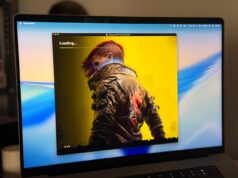
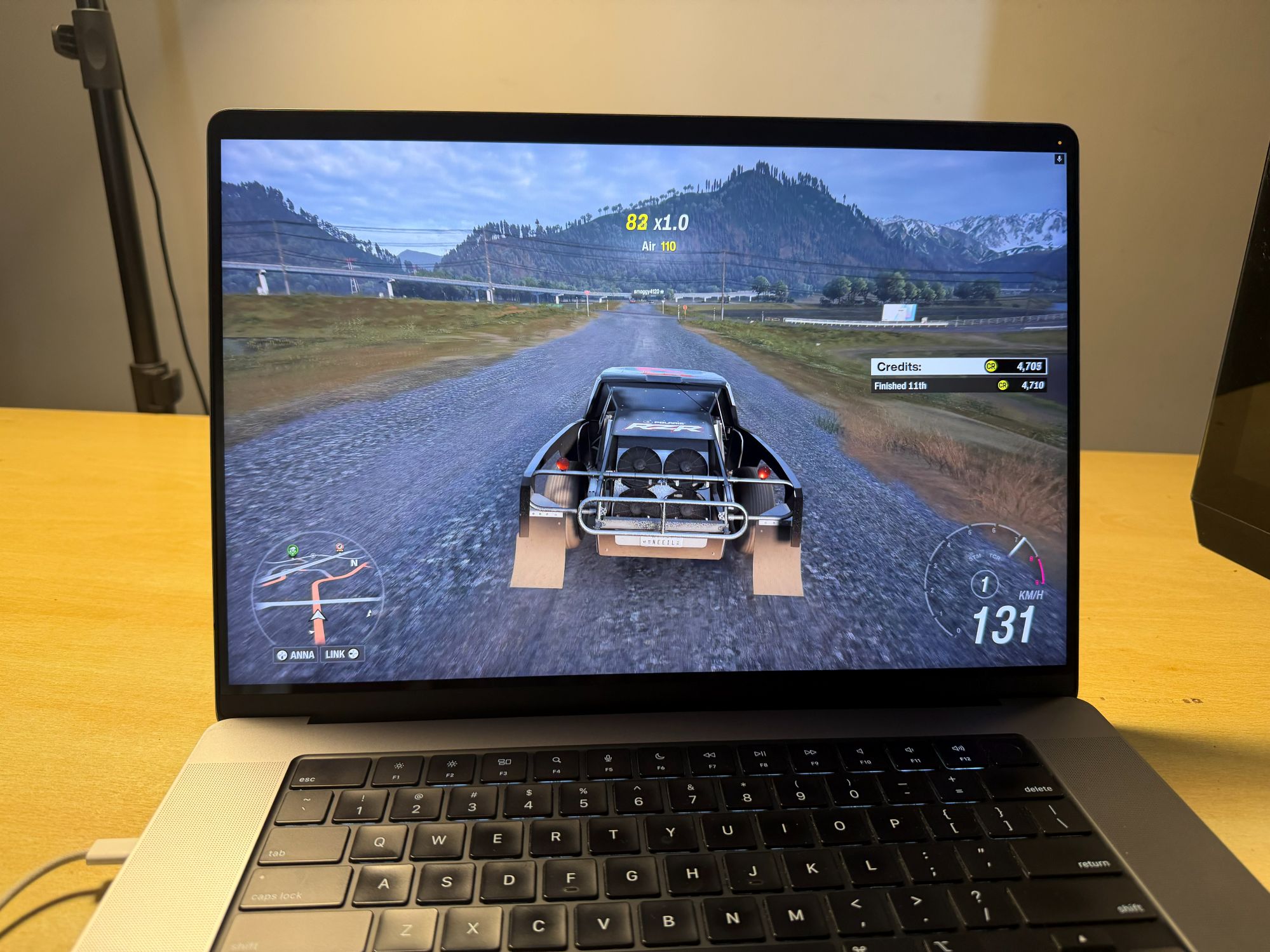
Let me talk about the machine I ran all of this on. A MacBook Pro 16, the M1, bought in 2021, five full years ago. This is the same unit I used to spend two years figuring out whether Apple Intelligence was worth switching on at all. It has aged well as a machine. Its AI story is a separate conversation.
It is one of the best laptops ever made, and I do not say that loosely. The Liquid Retina XDR display is a mini-LED panel with real local dimming, reference-grade colour, and a 120Hz ProMotion refresh. The six-speaker system is the finest you will hear on any laptop, full stop. Sixteen inches of screen, built like a vault, and battery life that still embarrasses the Windows field years on. As a canvas for games, it is superb. I have pushed this exact contradiction before, watching this same M1 chip trade blows with a dedicated RTX 5060 laptop through native ports alone. Good, but rare. GeForce Now makes that the norm instead of the exception.
And for years, it could not run most of them.
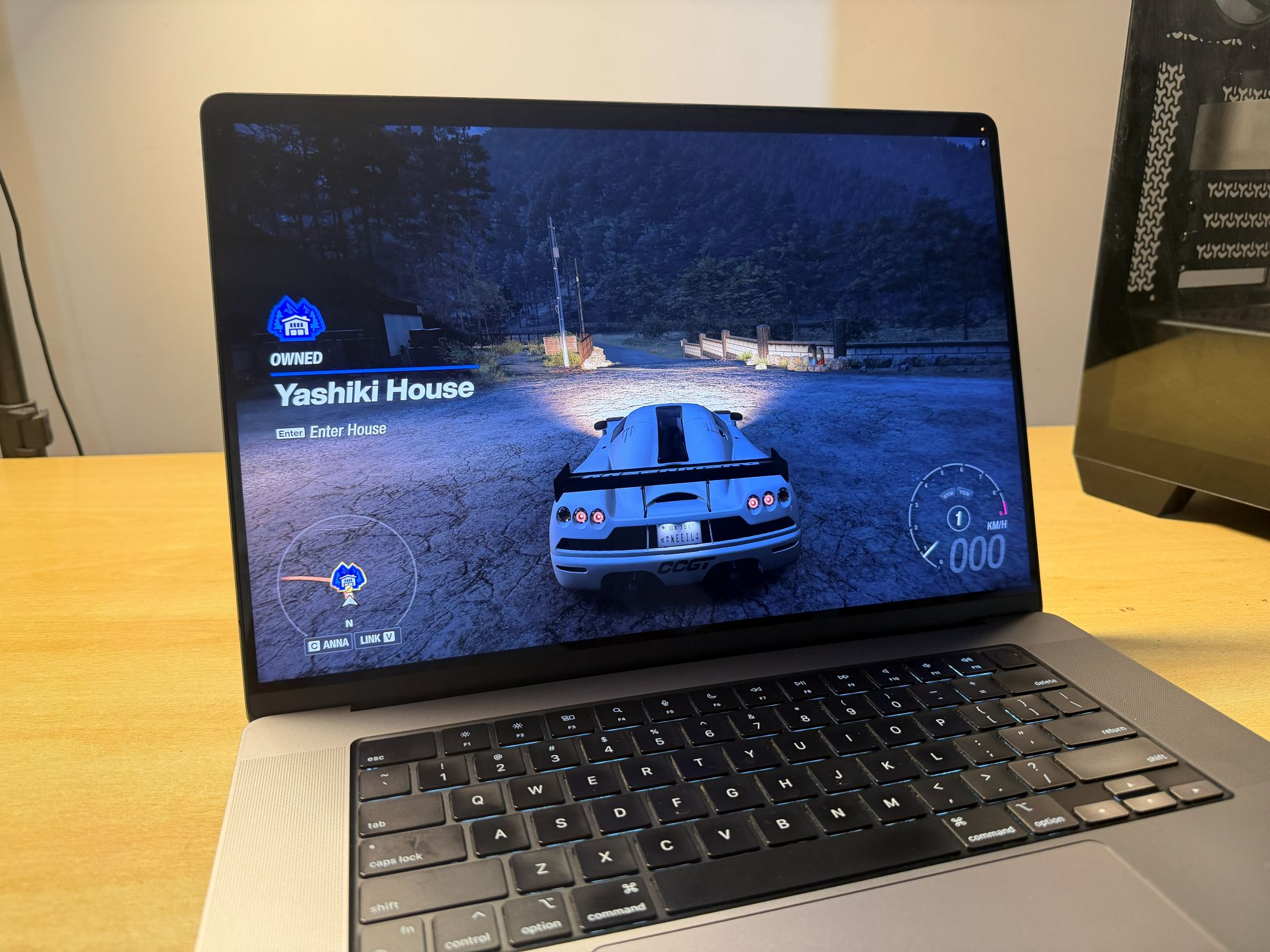
This is the Mac’s oldest contradiction. Apple builds the finest laptop hardware on the market, and games were never invited. Native Mac gaming going mainstream is a dream the industry (and me, personally) has chased for two decades and never delivered. I am not convinced it ever will.
That is exactly the gap GeForce Now fills. The dream native ports never made real, a datacentre makes real instead. The same games that were locked off my Mac now run at RTX quality, on that XDR panel, through those speakers.
I will go further, because it is where my recommendation has actually landed. Buying a Windows gaming laptop is a compromise, and I say that as someone who reviews them for a living. The specs look strong on a slide. Living with them is another matter. The bloat, the driver roulette, the fans, the battery that surrenders by mid-afternoon. Apple’s M chips rewrote the terms of that argument. The performance, the efficiency, the battery life that runs into double-digit hours, none of it has a real Windows answer. If the quality of daily use matters to you, the MacBook is the clear winner, and it is not close.
Pair that quality with GeForce Now, and the MacBook stops being a laptop that cannot game. It becomes a portable RTX 5080 machine that also happens to be the nicest computer in the room.
You get RTX 5080 gaming out of it without paying for a 5080.
When I game this way, the Mac stays cool and silent, because it is only decoding a stream. No throttling. No fan noise. No heat pooling under my wrists. On a laptop built this well, that restraint feels right.
The laptop you already own still counts
The same logic rescues the machine in your bag right now. Maybe you have an older laptop that still does everything you need. You do not want to spend on an upgrade, you do not want to build a desktop, but there is one game you have been dying to play properly. GeForce Now is a completely legitimate route to it. You are not buying a graphics card to play a single title. You are renting the horsepower for exactly as long as you want it, then handing it back. For a lot of people, that is the whole value proposition, and it is a sound one.
Latency is not the problem
Now the objection everyone raises first. Lag. I will meet it directly, because I have the hours to back this up.
I have over 3,000 hours in Dota 2. I play on SEA servers at around 76ms, and it has never held me back. On GeForce Now in Delhi, to the Mumbai datacentre, I measure about 27ms. That is less than half the latency of a game I have played competitively for years. Read that again. The cloud number is better than the number I already accept without a second thought. Most sessions, I forgot I was streaming at all.
My latency, side by side (lower is better)

The catch nobody warns you about is not latency. It is your Wi-Fi.
The real catch is your Wi-Fi
Here is the honest condition, and it is not the one you were bracing for. The experience lives and dies on your connection, not the servers.
You need to be wired, or in the same room as your router. Plug in Ethernet, or sit close on a clean 5GHz signal, and it is flawless. Move two rooms away and lean on a weak link, and it falls apart. The bandwidth for a clean 4K stream simply is not there, and you will blame the cloud for stutter that belongs to your own network.
NVIDIA’s own guidance, by resolution:
| Resolution and frame rate | Minimum speed |
|---|---|
| 720p at 60fps | 15 Mbps |
| 1080p at 60fps | 25 Mbps |
| 1440p at 120fps | 35 Mbps |
| 4K at 120fps | 45 Mbps |
Wired Ethernet or a strong 5GHz router is the recommendation across the board. Treat it as a requirement, not a suggestion. Get it right and the whole case for GeForce Now holds together. Get it wrong and none of the rest matters.
One rough edge worth flagging
One real flaw. I own DLC in Forza. Through GeForce Now, that content would not appear. Paid-for add-ons that did not carry across to the cloud instance. It is a store-entitlement issue, the kind of rough edge you expect this early, and I expect it to be fixed. But if your library leans heavily on DLC, know that it may not all come through cleanly yet.
Is it worth the money
This section needed a rewrite days after I first published it, and that tells its own story. GeForce Now has exited beta, and the pricing that comes with public availability is not the pricing I tested under. Memberships are now billed monthly, not sold as 90-day passes. Day passes still exist, for anyone who wants to try a single session before committing.
| Performance | Ultimate | |
|---|---|---|
| Price (monthly) | ₹999 | ₹1,999 |
| Day pass | ₹399 | ₹799 |
| Quality | Up to 1440p at 60fps | Up to 5K at 120fps |
| Server rig | RTX gaming rig | RTX 5080 SuperPOD (Blackwell) |
| DLSS 4 / Reflex | No | Yes, MFG + sub-30ms Reflex |
| Free cloud storage | 100GB single-session | 100GB single-session |
| Monthly hours cap | 100 hours | 100 hours |
| Best for | 1080p and 1440p players | 4K to 5K, HDR, competitive latency |
| GeForce Now Ultimate | Xbox Cloud (Game Pass Ultimate) | |
|---|---|---|
| Cost per year | ~₹23,988 (₹1,999/mo × 12) | ~₹16,668 (₹1,389/mo × 12) |
| Max quality | Up to 5K at 120fps | Up to 1440p at 60fps |
| The games | Your own library (Steam, Epic, Xbox, Ubisoft) | An included library you do not own |
The Bigger Picture
There is a strategic shift underneath this launch that I find genuinely interesting. For the first time, NVIDIA is selling directly to the Indian consumer. For years I bought their silicon through board partners and system builders. Now they are offering a service with their own name on it, in my own country, on Mumbai servers. That is a new relationship, and how it matures here will tell us a great deal about where this market goes next.
So, does it replace a desktop?
Almost. Not yet.
That is the honest reckoning. For portable gaming, for MacBook owners, for anyone who wants serious performance without buying, housing, and hauling the hardware, GeForce Now is already the smart choice. It runs cool, it runs silent, it costs a fraction of what it replaces, and the latency held up better than my instincts told me to expect.
But it still depends on your connection, the store and DLC edges still need filing down, and the hour cap is a real limit. My desktop answers to none of that. So the desktop stays, for now.
If you are on a Mac, or talking yourself into a ₹2.5 lakh gaming laptop, try GeForce Now first. You may reach the conclusion I did. The expensive machine was solving a problem the datacentre had already solved.