
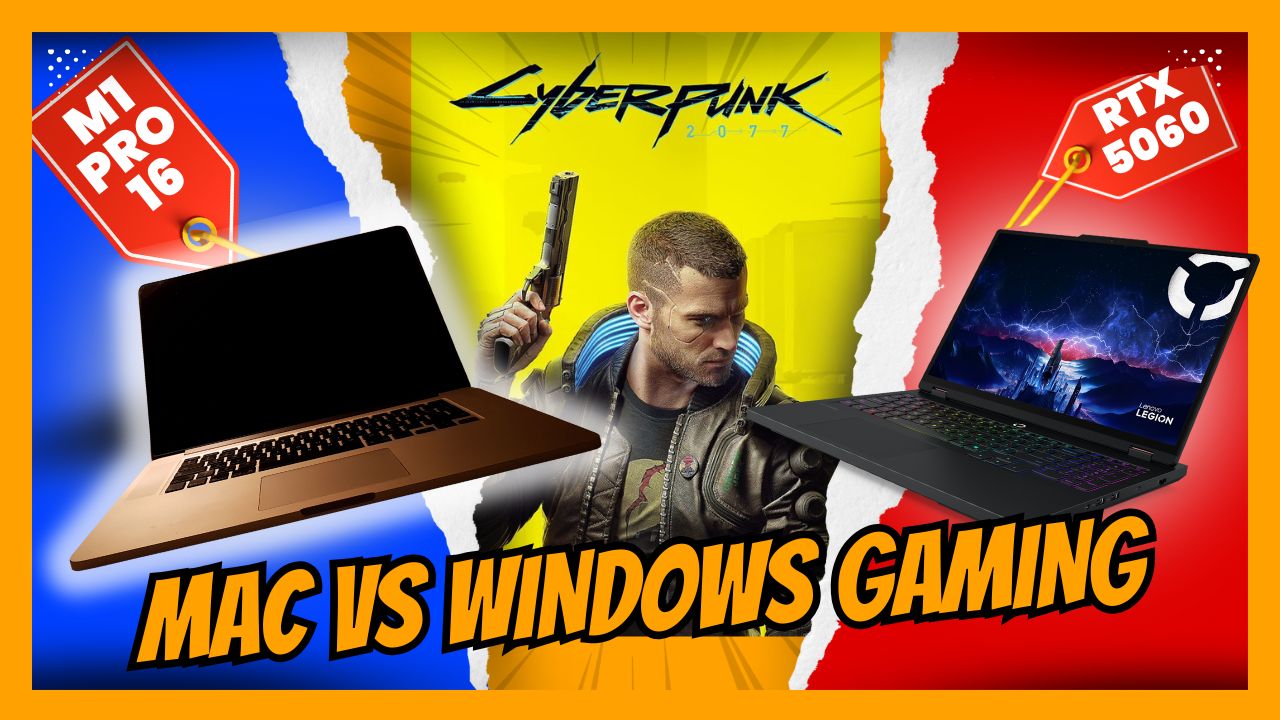
This comparison began with a straightforward goal: finish Cyberpunk 2077 on two fundamentally different machines under similar gameplay conditions, using identical input hardware and targeting a consistent 60 fps experience. Both runs were completed using the built-in keyboards and the same Logitech Superlight Pro mouse to eliminate input variability.
In the Indian market, the pricing contrast between these platforms is striking. A refurbished MacBook Pro 16-inch with the M1 Pro or M1 Max now sells for around ₹75,000, making it far more accessible than at launch. The latest MacBook Pro 16-inch with the M4 Pro, however, starts near ₹2.5 lakh. By comparison, Windows gaming laptops equipped with the RTX 5060 typically begin around ₹1,20,000. This difference in cost directly influences the value proposition for both casual and dedicated gamers.
Running Cyberpunk 2077 on the MacBook Pro 16-inch (M1 Pro) required tuned settings. At 1080p with medium and low presets, the game consistently delivered around 55–65 fps throughout the entire playthrough. The thermal behaviour was predictable: the machine became warm across the top deck and palm-rest area, but not uncomfortably so, and fan noise remained controlled. I detailed these settings in my earlier article I tried Cyberpunk 2077 on my MacBook Pro M1 Pro and I’m shocked at what Apple just pulled off, which outlines how Apple Silicon handles such demanding workloads.
Battery behaviour is where Apple Silicon continues to show its advantage. During gaming on battery power, the MacBook Pro 16-inch can sustain light to moderate gaming for roughly two to two and a half hours. Importantly, it maintains full performance even when unplugged, which is not the case with most Windows gaming laptops. An RTX 5060 laptop typically drains its battery in about 40–60 minutes when running a game of this scale, and performance often drops sharply unless it is connected to the charger. For short gaming sessions away from a wall socket, the MacBook’s stability is unmatched.
Native Mac games are significantly easier to run, as there is no bloatware, no background processes fighting for resources, and no need to manipulate power profiles or thermal modes to access full performance.
Gaming on macOS also benefits from the platform’s inherent efficiency. Native Mac games are significantly easier to run, as there is no bloatware, no background processes fighting for resources, and no need to manipulate power profiles or thermal modes to access full performance. A Mac simply runs at its intended performance level without requiring the user to intervene. This stands in contrast to the Windows experience, where achieving consistent performance often involves adjusting power plans, monitoring thermals, and disabling unnecessary software. For many users, this simplicity is a major advantage, particularly for titles that support native Metal builds.
The RTX 5060 laptop delivered the more traditional PC gaming experience. At native 1080p on the High preset with DLSS set to Quality, frame rates hovered between 75 and 90 fps in open areas, and stayed comfortably above 60 in dense parts of Night City. Visual fidelity was clearly superior, with richer lighting, improved post-processing, and greater detail density. Thermally, the laptop operated at far higher temperatures, and the WASD region became hot quickly under sustained load. Fan noise was typical of a gaming laptop—prominent but expected.
The M4 Pro improves Apple’s GPU capabilities significantly. While it brings higher shader performance, greater efficiency, and smoother frame pacing compared to the M1 Pro, it still does not match the raw rasterisation strength of the RTX 5060. The advantage it provides is reduced compromise rather than parity. This trend is part of a broader dynamic I explored in Apple’s supremacy with Apple Silicon laptops might just be under threat from NVIDIA and Intel, where the shifting balance between Apple’s efficiency and PC’s raw performance is becoming more pronounced.
The M4 Pro improves Apple’s GPU capabilities significantly. While it brings higher shader performance, greater efficiency, and smoother frame pacing compared to the M1 Pro, it still does not match the raw rasterisation strength of the RTX 5060.
Both machines completed Cyberpunk 2077 reliably, though in different ways. The MacBook required adjusted visual settings but delivered a stable, predictable experience with excellent battery consistency and lower noise. The RTX 5060 laptop offered superior visuals and higher frame rates, though at the cost of heat, noise, and near-total dependency on wall power.
The choice between the two systems ultimately depends on user intent. For millennials—or anyone—who plays occasionally but spends the majority of their laptop time on productivity, browsing, content consumption, or writing, the MacBook Pro remains the more suitable device. macOS offers a cleaner, more refined workflow, better battery life, and fewer distractions. It avoids the operational inconsistencies of Windows, and for non-gaming tasks, it is more reliable, more predictable, and more pleasant to use. Steam’s recent move to support Apple Silicon natively, as I covered in Steam is finally native on Apple Silicon , only strengthens the argument for macOS as a practical casual gaming platform.
The MacBook required adjusted visual settings but delivered a stable, predictable experience with excellent battery consistency and lower noise. The RTX 5060 laptop offered superior visuals and higher frame rates, though at the cost of heat, noise, and near-total dependency on wall power.
However, if gaming is the primary workload, the decision becomes simple. A Windows laptop with an RTX 5060 will deliver far stronger performance and better visual quality for significantly less money than a new MacBook Pro. Heat and fan noise are part of the package, but the performance advantage is undeniable.
Looking forward, the future of Mac gaming is improving steadily. Apple is investing in better tools, more efficient GPU architectures, and clearer pathways for developers. Game Mode, Metal 3, and the Game Porting Toolkit have created real momentum. Yet, despite these advancements, Windows remains the superior platform for modern AAA gaming. macOS is evolving rapidly, but it has not yet displaced the dominance of PC hardware for dedicated gamers.
For millennials—or anyone—who plays occasionally but spends the majority of their laptop time on productivity, browsing, content consumption, or writing, the MacBook Pro remains the more suitable device. macOS offers a cleaner, more refined workflow, better battery life, and fewer distractions.
At present, the MacBook Pro is a strong all-purpose laptop capable of handling occasional gaming with surprising competence, while the RTX 5060 laptop remains the clear choice for users who prioritise gaming performance above all else.