DLSS 5 is officially live. RTX 50 series only, desktop and laptop, plus GeForce NOW. Nothing older gets it, no fallback path, no “coming to Ada later.”
One game ships with it today, and that game is NBA 2K27. But the roster behind it is not small, and it is the roster rather than the launch title that tells you what this technology is actually for.
I have been sitting with NVIDIA’s own numbers for two days now, and the thing I keep coming back to is not the yassified faces or the Kingdom Hearts memes. Everyone has covered that. The thing I keep coming back to is that this is the first DLSS feature in eight years that takes performance away from you instead of giving it back. And I want to talk about what that means when you are buying a graphics card in Delhi rather than in California.
First, what DLSS 5 actually is
Forget the name. DLSS 5 is not an upscaler and it is not frame generation. NVIDIA calls it 3D-Guided Neural Rendering, and it sits at the very end of your graphics pipeline as a separate pass.
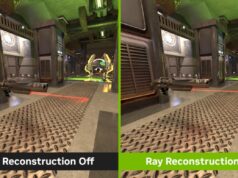
Your game renders a frame normally. Then a diffusion model takes that frame’s colour and motion vectors and paints new lighting and material detail on top of it. Subsurface scattering in skin. Light passing through hair and foliage. Tighter contact shadows. Deeper ambient occlusion. It is genuinely clever engineering. It runs deterministically, one frame in and one frame out, so it does not shimmer or drift the way a video model would. Developers get intensity sliders, semantic masking and a choice of models, so a studio can dial it back on faces and push it on environments.
For you and me it is a single on or off toggle in the settings menu.
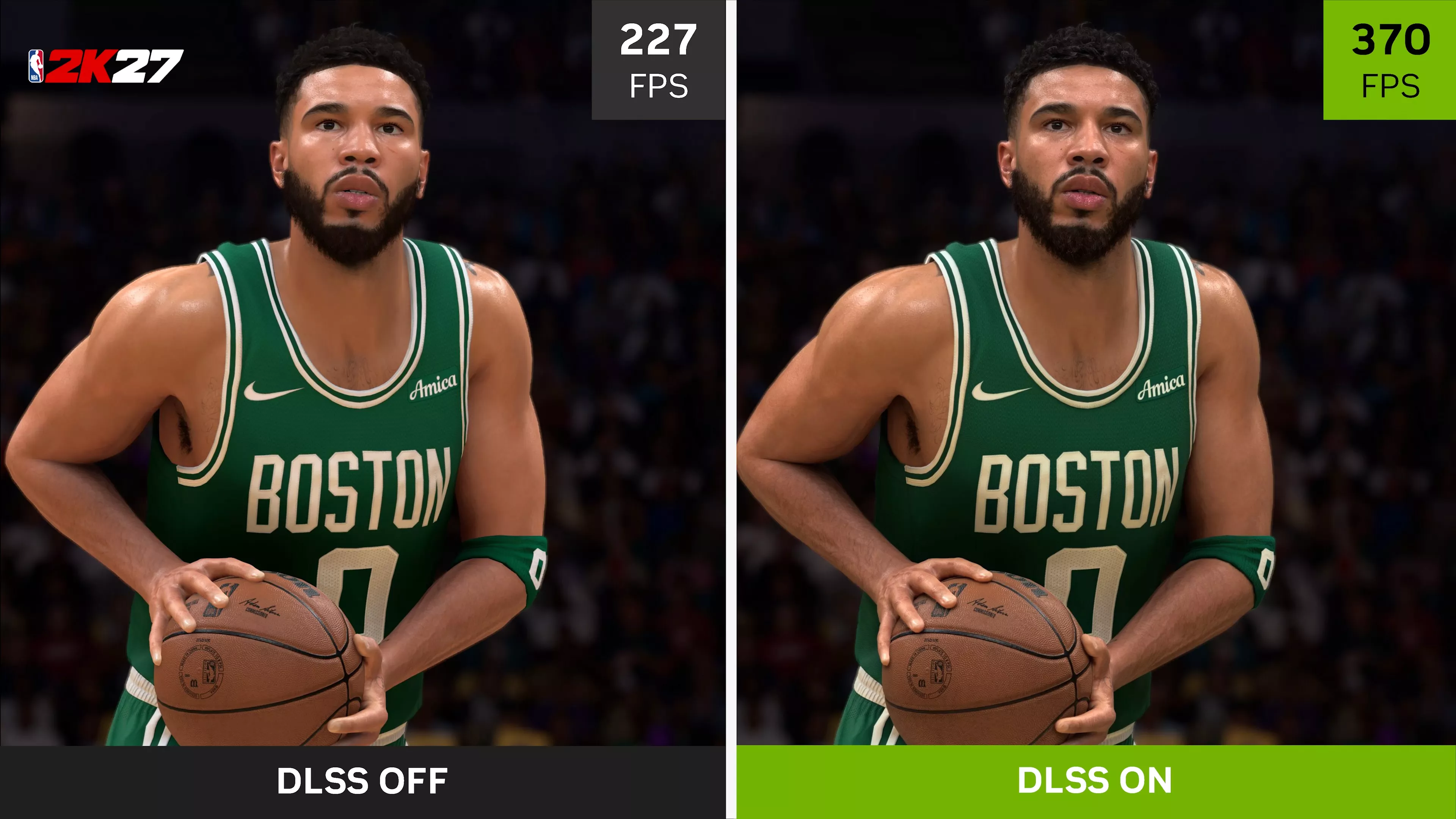
The visual results, when the input is already photoreal, are legitimately impressive. Sports games look outstanding. That is not a coincidence, and it is not an accident that the launch title is a basketball game.
Look at the games list before you look at anything else
NVIDIA named fifteen titles back in March. AION 2. Assassin’s Creed Shadows. Black State. Cinder City. Delta Force. Hogwarts Legacy. Justice. Naraka Bladepoint. NTE: Neverness to Everness. Phantom Blade Zero. Resident Evil Requiem. Sea of Remnants. Starfield. The Elder Scrolls IV: Oblivion Remastered. Where Winds Meet.
Read that list again and count the Chinese live-service games. AION 2, Justice, Naraka, NTE, Where Winds Meet, Sea of Remnants, Delta Force, Phantom Blade Zero. Eight out of fifteen, from Tencent, NetEase, NCSOFT, Hotta Studio and S-GAME. The western contribution is essentially Bethesda’s back catalogue, one Ubisoft title and one Capcom title.
This matters more than it looks. A big chunk of that roster is free to play, and several of those games are competitive or PvP-heavy. Delta Force and Naraka are shooters and brawlers where people care about their reaction time. Free to play means the audience skews toward budget hardware by definition. So the launch roster is asking players who chose a game because it costs nothing to run it on a card that costs two lakh, and then to give up more than half their frame rate in a genre where latency decides fights.
There is a version of DLSS 5 that makes complete sense: single-player, photoreal, slow, cinematic. Starfield. Oblivion Remastered. Resident Evil Requiem. NBA 2K27, watched more than it is played. That is the tech doing what it is good at. The rest of the list is NVIDIA collecting logos.
The number NVIDIA is not putting on a slide
Switching the neural rendering pass on costs somewhere between 50 and 60 percent of your frame rate. That is NVIDIA’s official figure. Look at what that does to the launch charts. At 4K with ray tracing on the Ultra preset, NVIDIA shows an RTX 5080 at 233 FPS and an RTX 5090 at 370 FPS. Big, comfortable numbers. Then you read the footnote: those runs use Multi Frame Generation in 6X mode with Super Resolution set to Performance.
Strip the interpolation away and the 5080 is rendering at roughly 39 frames per second. The 5090 lands around 62.
Thirty-nine. On a card that costs above two lakh rupees.
And notice which cards appear on that 4K chart. The 5080 and the 5090. That is the entire list. There is no 5070 Ti, no 5070, no 5060 Ti, because at 4K with this pass enabled those cards would be rendering at frame rates NVIDIA does not want printed next to its own logo.
The leaked build backs the official figure up. Testers running the pre-release DLL saw a 5070 Ti drop from 71 to 35 FPS at 4K in Control. A 5090 went from 91 to 50. A 5060 fell from 86 to 34. Different games, different scenes, same story every time. Roughly half your performance, gone, in exchange for better skin.
The Indian Context
DLSS 5 is exclusive to RTX 50 series hardware. Fine. That is NVIDIA’s prerogative and Blackwell’s Tensor cores are doing real work. But look at what the 50 series costs in this country right now.
The 5090 launched here with a Founders Edition price of around Rs 2,19,000. Its twelve month median across Indian retail sits near Rs 3,08,000. Today, thanks to the global memory shortage squeezing every GDDR7 card on the shelf, listings for popular AIB models are running between Rs 4,50,000 and well past Rs 6,00,000. The 5080 sits roughly between Rs 1,55,000 and Rs 2,10,000 depending on which partner card you can actually find in stock. The 5070 Ti hovers around Rs 1,47,000.
Now the laptop side, which is where most Indian buyers actually live. An RTX 5070 laptop with 8GB of VRAM is landing in machines around Rs 2,75,000. A 5080 laptop is Rs 3,59,990. A 5090 laptop is knocking on Rs 4,90,000. These are not niche halo products in India. These are the mainstream gaming laptop stack, and people are financing them on EMI.
So the proposition NVIDIA is putting to an Indian buyer tonight is this. Pay a global-crisis premium on hardware that is already the most poorly priced it has been in this market in years. Then hand back half of what you paid for, so that a basketball player’s ear looks translucent.
I do not think that is a good deal. I do not think it is close to a good deal.
The frame time problem nobody wants to say out loud
I made a video a few weeks ago arguing that native rendering still beats DLSS plus multi frame generation on visual and animation quality, and that 90fps is the number to chase for genuine smoothness, and that frame times and stutter matter far more than whatever your FPS counter says. I stand by every word of it, and DLSS 5 has made the argument easier to make.
If your card is rendering at 39 real frames per second and MFG 6X is inflating that to 233, your input latency is still the latency of a 39fps game. The counter is lying to you in the most literal way a counter can lie. Your mouse still feels like it is dragging through wet sand. The animation still has the interpolation softness that any of us who look closely can spot in a panning shot.
For a basketball sim you are watching more than you are twitch-aiming, so the tradeoff is survivable. Try the same maths in a competitive shooter or a fast action game and it falls apart. NVIDIA has effectively built a photo mode that runs at sixty frames a second, and it is asking to be judged as a rendering breakthrough.
Where I do give NVIDIA credit
The optimisation curve is real. When this was shown at GTC in March it needed two RTX 5090s to run at all, one of them dedicated purely to the AI workload. Six months later it is running on a single card, including laptop GPUs, at roughly five times the speed. Half of that gain arrived by May and a further two and a half times by July. More is promised this autumn.
That is a serious pace, and if it continues then the 50 to 60 percent figure is a launch number rather than a permanent tax. Worth remembering before anyone declares the whole idea dead.
It is also genuinely optional. Developers choose whether to ship it, artists choose how hard to apply it, and you can leave it switched off and carry on using Super Resolution and frame generation exactly as before. Nobody is forcing this into your games.
But optional does not mean free of consequence. Once a feature exists and a GPU vendor markets it as the reason to upgrade, it starts shaping which cards get recommended and which ones get called obsolete. That pressure lands hardest on buyers in markets like ours, where the gap between what a card costs in dollars and what it costs in rupees has never been wider.
What I would actually tell you to do
Do not buy a graphics card for DLSS 5. Not this month, not this quarter. But well, were you really buying an RTX GPU exclusively for DLSS 5? I don’t think so. Fact of the matter is that NVIDIA’s AI stack for gaming is far more superior than what the competition offers.
Only one game officially supports it, for now. And the fifteen announced titles have no dates attached to them.The performance cost is brutal and is being hidden behind interpolation in every chart NVIDIA has published. The visual benefit is largest in exactly the genre where you are least likely to notice it during play, and smallest or actively harmful in anything with a stylised art direction, which is most of what is worth playing.
If you already own a 50 series card, turn it on in NBA 2K27, look at it properly, and then decide whether translucent ears are worth what your frame time graph does when you enable it. That is a five minute test and you do not need my permission to run it.
If you are shopping right now, the honest advice has not changed. Buy for the native frame rate you can hold at your resolution. Chase 90fps and clean frame pacing. Treat everything NVIDIA adds on top as a bonus you might use, not as a feature you are paying for.
I will have hands-on numbers from my own bench once the driver drops and I can put this through a proper frame time analysis rather than a marketing slide. Until then, hold on to your money. In this market, that is the highest value setting available.