There is a number doing the rounds this week across the compute community: 35% more compute capability, 20% more parameters, no performance cost. It is in every write-up of Nvidia’s new DLSS 4.5 Ray Reconstruction model, usually stated as fact. Considering Nvidia’s numerous bold performance claims in the past, disguised under its AI-powered technologies, we were skeptical, but with an open mind.
It is worth saying plainly, before anything else: that number comes from Nvidia. Every figure attached to this launch traces back to Nvidia’s own materials. At the time of writing, not one independent outlet has published frame time data of its own. That does not make the claims wrong. Nvidia’s DLSS numbers have generally held up, and the underlying change here is real and overdue. But there is a difference between “measured” and “repeated”, and most of this week’s coverage is the second thing wearing the clothes of the first.
So here is what DLSS 4.5 Ray Reconstruction actually is, what Nvidia is promising, and the specific claims worth holding loosely until somebody (us!) puts a capture card on them.
What Ray Reconstruction actually does
Ray Reconstruction is the DLSS feature that get’s the most credit for being the least understood.
Super Resolution (DLSS) upscales. Frame Generation (MFG) invents frames. Ray Reconstruction does neither. It is a denoiser, with significant impact in visual fidelity and more on performance..
When a game path traces a scene, it cannot afford to fire enough rays to light every pixel properly. It fires a sparse handful and hands back a noisy, speckled image. Traditionally a stack of hand written denoisers cleans that up, one for shadows, one for reflections and one for global illumination, each throwing away real detail in order to hide the noise.
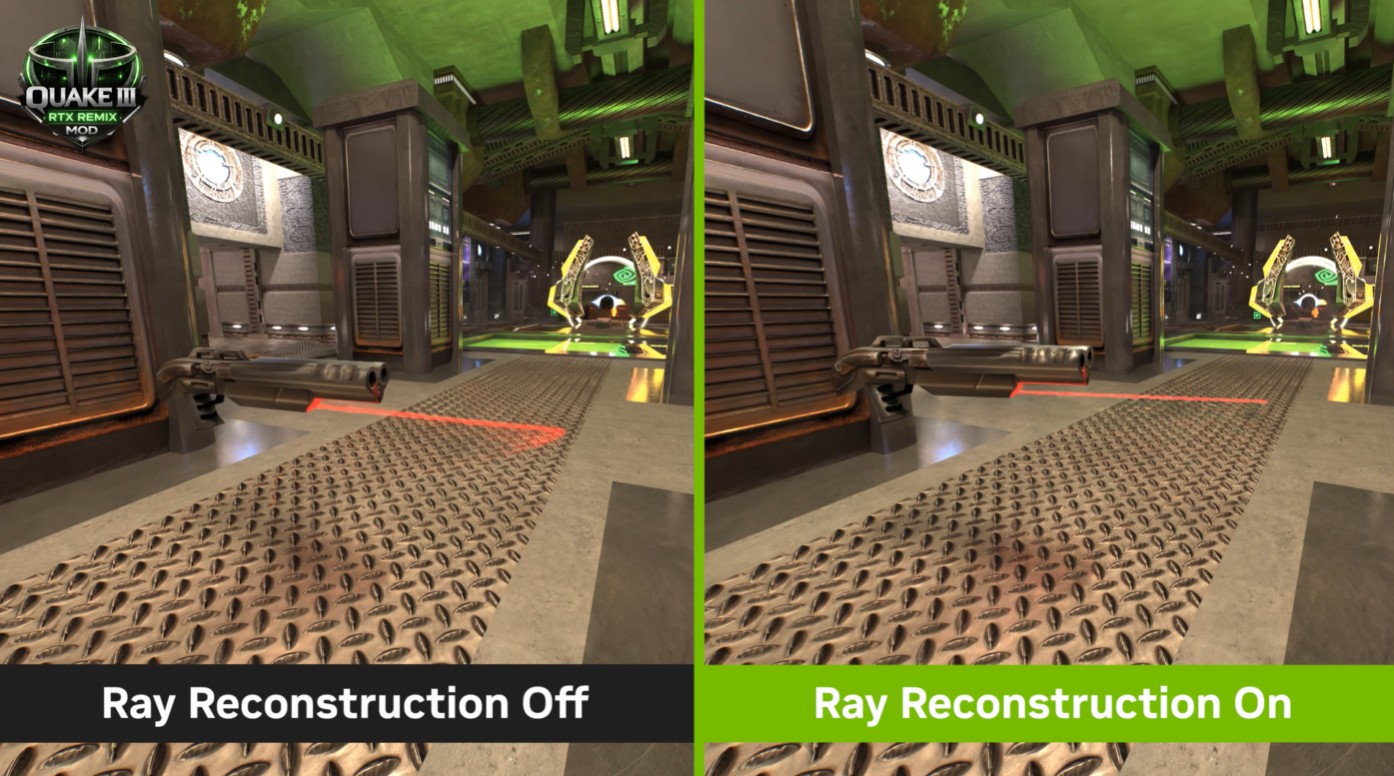
Ray Reconstruction replaces that stack with a single neural network trained on an Nvidia supercomputer. It takes the noisy frame plus temporal and spatial data from the engine, and infers what the unsampled pixels should have been. Critically, it folds denoising and Super Resolution into one model rather than running them as separate passes that fight each other over the same pixels.
It arrived in September 2023 with DLSS 3.5, built on a convolutional neural network. DLSS 4 swapped that CNN for a transformer in early 2025. That was some real progress, but it bought along with it its own set of problems.
The gap DLSS 4.5 left open
Nvidia announced DLSS 4.5 at CES 2026 on January 6. The headline was a second generation transformer for Super Resolution, which Nvidia says uses five times the compute of the original transformer model and works in linear space for better lighting accuracy. Dynamic Multi Frame Generation and the 6X mode followed on March 31.
DLSS got the new architecture, but Ray Reconstruction did not.
To make matters worse, the two were incompatible. Switching Ray Reconstruction on effectively dropped you back to the older DLSS 4 model, discarding the DLSS 4.5 image quality improvements you had just enabled. Anyone running path tracing in Cyberpunk 2077 or Alan Wake 2, which is to say exactly the audience Ray Reconstruction exists for, was picking between the better upscaler and the denoiser their game needed.
That is the gap this release fills. It actually makes DLSS 4.5 feel complete, finally.
What Nvidia says is new
Here are the claims Nvidia makes:
- 20% more parameters processed than the outgoing model
- Roughly 35% more compute capability, while maintaining similar performance to the previous model
- An expanded training dataset, which Nvidia frames as improving the model’s ability to pick the most accurate engine data when reconstructing a scene
- Deeper spatial awareness across the scene, with more intelligent use of engine pixel sampling and motion data
- Finer developer control over temporal accumulation, letting studios tune model response per title
That last item is the one I would watch. Temporal accumulation is the root cause of most Ray Reconstruction complaints: hold too much history and you get ghosting and smearing, hold too little and you get boiling and instability. A fixed behaviour is why the old model could look excellent in one game and poor in the next. Handing developers the ability to adjust to this is a legit structural fix that scales well with complexity, assuming studios actually use it.
The named targets are exactly the historical weak spots: particle effects, drifting smoke, sparks, rain, and foliage. Small, fast moving, high frequency detail. The things that previously turned a rainy scene into an oil painting.
The performance claim, and its “special conditions”
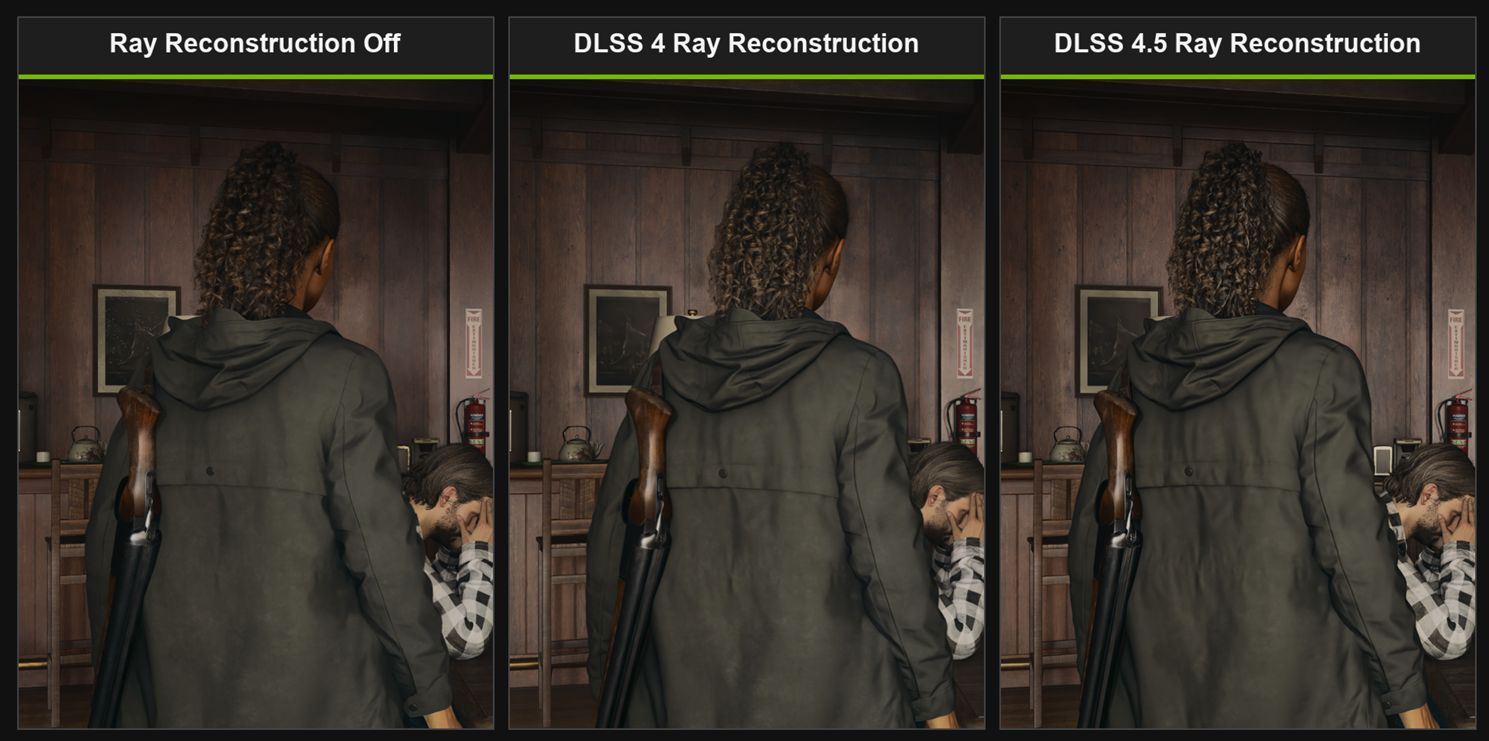
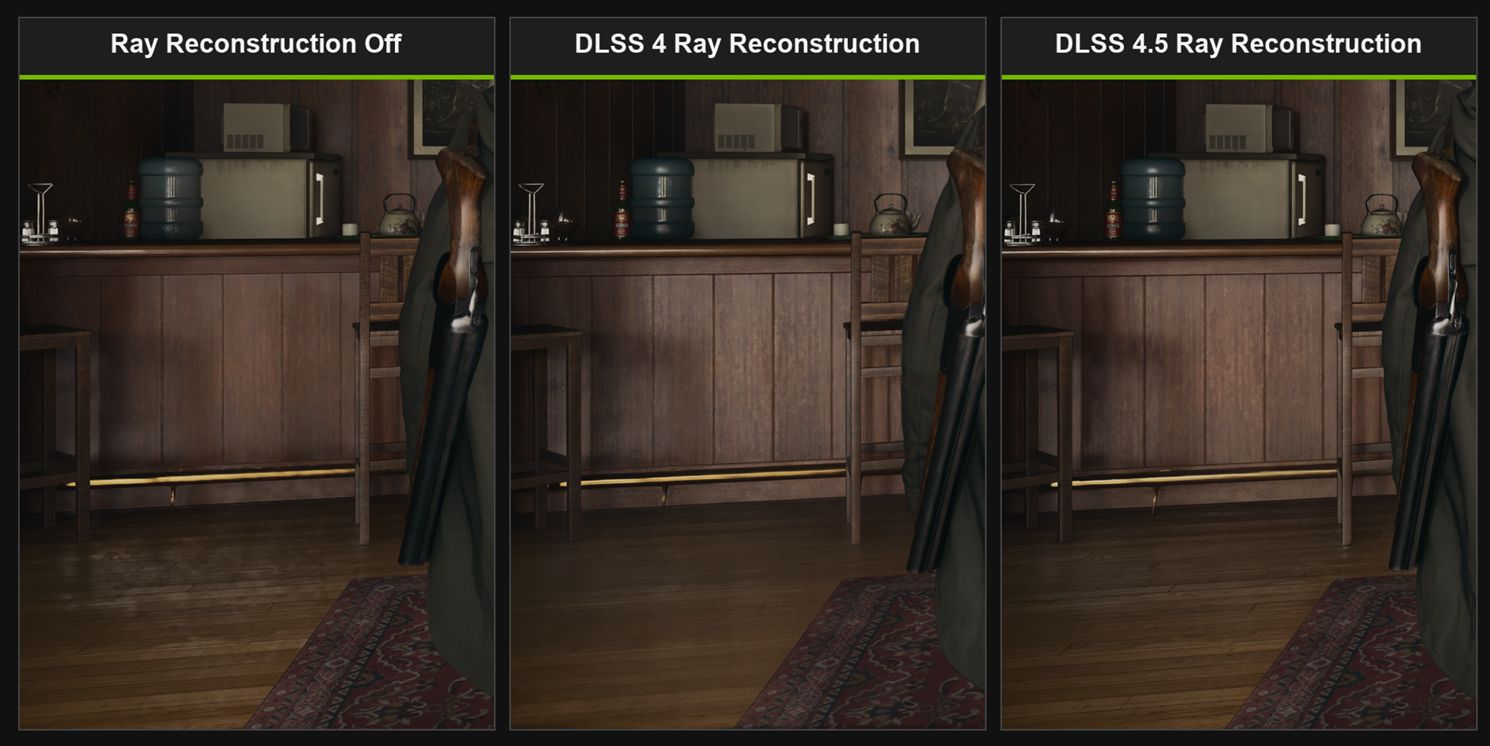
clearer fabric folds, and more stable fine texture, while maintaining smoother, more natural lighting than
RR Off or the previous RR mode
This is the claim that will decide whether people leave Ray Reconstruction on, and it is the one with the least independent support.
Nvidia’s position is that the extra capacity is spent on quality rather than handed back as frames (we approve of this thinking), so the new model performs roughly in line with the old one. Community testing on the leaked pre release build, including at 4K, has reported essentially no frame rate change. That is directionally encouraging and consistent with Nvidia’s framing.
It is also not a review. It is scattered enthusiast testing on an unreleased DLL, without controlled runs, matched scenes, or frame time percentiles. Average FPS parity can coexist with worse 1% lows, and a denoiser is exactly the kind of workload where that can happen. Nobody has published the data that would settle it. Our system is having its own set of issues dealing with activating the Beta driver to access the features.
Treat “free image quality upgrade” as a well supported expectation rather than an established fact, at least until the first proper reviews land.
Which GPUs are getting DLSS 4.5 Ray Reconstruction
All of them: RTX 20, 30, 40, and 50 series. This is not Multi Frame Generation, which stays locked to the 50 series. Ray Reconstruction has always been open to the entire RTX line.
Nvidia itself notes that while the update is fully compatible with RTX 20 and 30 series cards, architectural limitations in those generations may produce a minor performance delta. Those older cards lack native FP8 support, which is precisely why heavier transformer models cost them more, the same issue that applied at the DLSS 4.5 Super Resolution launch.
So “free upgrade for every RTX GPU” is true in the sense that everyone can run it. It is not necessarily true in the sense that it costs everyone nothing. If you are on a 2070 or a 3070, which is a large share of the actual installed base, check your own frame times rather than trusting the headline.
The launch games
Nvidia has confirmed 27 titles supporting DLSS 4.5 Ray Reconstruction at launch:
Alan Wake 2, Avatar: Frontiers of Pandora, Backrooms: Escape Together, Call of Duty: Black Ops 7, Crimson Desert, Cyberpunk 2077, Death Relives, Directive 8020, DOOM: The Dark Ages, Enlisted, EVERSPACE 2, F1 25, FBC: Firebreak, Half-Life 2 RTX, Hogwarts Legacy, Incursion Red River, Indiana Jones and the Great Circle, NARAKA: BLADEPOINT, NTE (Neverness to Everness), Portal with RTX, PRAGMATA, Resident Evil Requiem, Samson, Star Wars Outlaws, Subliminal, Sword of Justice, The First Descendant.
Every marquee path tracing showcase is on the list, which is what counts, because Ray Reconstruction does nothing meaningful in a game without significant ray traced lighting in the first place.
Oh and Nvidia paired this announcement with a milestone: the RTX ecosystem has now passed 1000 games and apps.
DLSS 4.5 Ray Reconstruction Hands On
The Call of Duty: Modern Warfare 4 beta shipped with a DLSS package containing the new Ray Reconstruction model and a previously unseen Preset F, replacing Preset D. DLSS Swapper has since indexed the files, and people have been running them in Alan Wake 2, Resident Evil Requiem, Cyberpunk 2077, Crimson Desert and Hogwarts Legacy.
Reported results: visibly sharper output where the old model went soft, better stability in fully path traced scenes, less blur on metal surfaces, reduced ghosting on fast motion.
These are all very useful and functional upgrades. But these are screenshots from enthusiasts on a pre release build, self selected for showing a difference, which is close to the least rigorous form of image quality evidence there is. The direction of travel looks right. The magnitude is unestablished. We plan on closing this app as the Nvidia app gets more stable.
As for doing it yourself: do not bother. Official support is imminent, swapping DLLs into anti cheat protected games is a good way to create problems you did not have, and you get the same model for free through the Nvidia app shortly.
Ray Reconstruction is coming to Blender
Similar to Nvidia’s financials, where gaming is more of an anomaly rather than a driver, the most consequential item in the announcement is related to Blender. Ray Reconstruction is coming to Blender as a denoiser option in Blender 5.3 this Fall, alongside Nvidia OptiX.
Anyone who has done lookdev in Cycles knows the loop: nudge the camera, wait for the viewport to resolve, nudge again, wait again. Replacing that with a neural denoiser that stabilises almost immediately changes how the work feels, not just how long it takes. Near final image quality in an interactive viewport is a larger practical win for 3D artists than a few percent of frame rate is for gamers.
What to actually watch for when real testing lands
When the first proper reviews arrive, the useful questions are narrower than “does it look better.” It will look better in stills. Specifically:
- Frame time percentiles, not averages. Does 1% low performance hold, or does average FPS parity hide new stutter?
- Motion, not screenshots. Rain, sparks, foliage, fast camera pans. That is where every previous denoiser fell apart and it is the entire pitch here.
- The RTX 20 and 30 series delta. Nvidia has admitted there is one. Nobody has quantified it. That affects more users than the 50 series result does.
- Per game variance. With developers now able to tune temporal accumulation themselves, quality may diverge sharply between titles that bothered and titles that shipped defaults.
The verdict, held loosely
DLSS 4.5 Ray Reconstruction is the least glamorous kind of upgrade and potentially one of the most useful. No new hardware, no new tier, no purchase required. It closes an architectural gap that should not have existed, and it targets precisely the artifacts people have complained about since 2023.
If Nvidia’s claims hold, path tracing stops looking like a tech demo with a smudge on the lens and starts looking like a rendering mode you simply leave on.